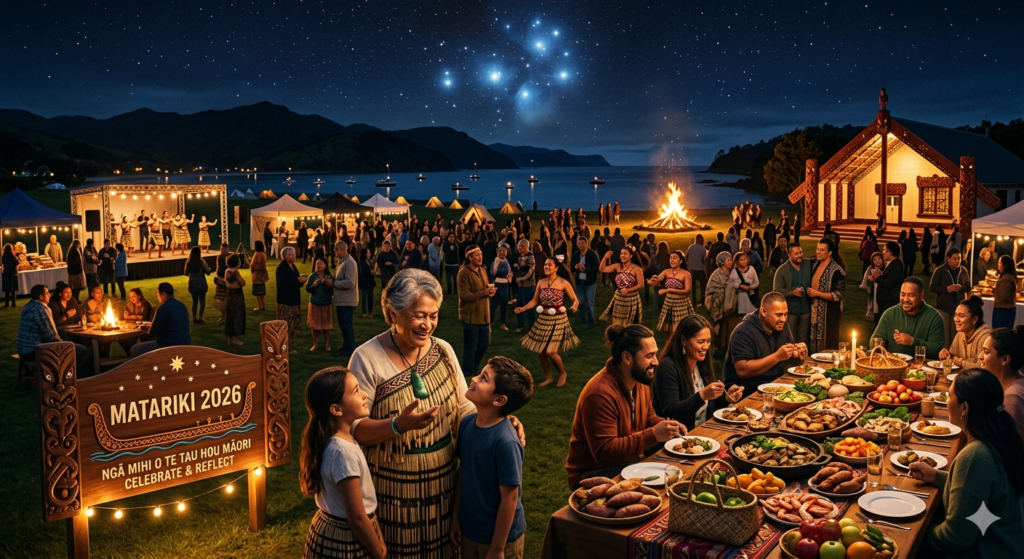
The lucky number for Matariki 2026 is 9 — associated with positive energy, good fortune, completion and collective service — calculated from the date 10 July 2026 (1+0+0+7+2+0+2+6 = 18 → 9), with lucky colours gold and yellow and lucky stone sapphire. Matariki 2026 will be observed on Friday 10 July 2026, marking the Māori New Year and New Zealand’s official public holiday honouring the rising of the Matariki star cluster (the Pleiades). The 2026 theme is Matariki herenga waka — a celebration of waka (canoe) heritage and the navigational wisdom of the ancestors. Matariki is a time of remembrance for those who have passed, gratitude for the abundance of the earth and sea, and the setting of intentions for the year ahead. The national celebration will be held at Tākaparawhau in Tāmaki Makaurau (Auckland), hosted by Ngāti Whātua Ōrākei.
Lucky Number
9 — Completion & Service
Lucky Colours
Gold & Yellow
Lucky Stone
Sapphire
Expression Number
1 — Purpose & Talents
What Is Matariki and Why Is It Celebrated?
Matariki is the Māori name for the star cluster known in Western astronomy as the Pleiades — a grouping of stars in the constellation Taurus that has been observed and celebrated by indigenous and ancient cultures on every continent of the world. For Māori, the people of Aotearoa New Zealand, Matariki holds a significance that goes far beyond its astronomical identity as a star cluster. It marks the beginning of the Māori New Year, a time structurally equivalent to the most important turning points in other major astrological and cosmological traditions — the Celtic Samhain, the Chinese Lunar New Year, in that it signals the end of one annual cycle and the beginning of the next.
The word Matariki itself has two widely recognised interpretations. The first is Mata Ariki, meaning “eyes of god” — a reference to the cluster’s role as a divine sign read by tohunga (expert practitioners) to understand what the coming year held for the community. The second is Mata Kī, meaning “tiny eyes” — a more astronomical description of the cluster’s appearance in the pre-dawn sky. Both interpretations point toward the same essential truth: Matariki is a time of seeing — of looking back at what has passed, looking up at what the stars are signalling, and looking forward with clear-eyed intention at what is to be created in the year ahead.
Matariki became an official New Zealand public holiday in 2022 — the first new public holiday to be added to the New Zealand calendar in decades and the first in the world to be specifically dedicated to an indigenous astronomical event. The date changes each year because it is aligned with the lunar calendar: Matariki is always observed on the Friday following the new moon that occurs after the star cluster’s first visible rising in the pre-dawn sky, which happens each year in late June or early July. For full official information about the history and significance of Matariki, the authoritative reference is the Te Papa Tongarewa resource on the Government website.
When Is Matariki 2026?
Matariki 2026 will be observed on Friday, 10 July 2026. This is the official New Zealand public holiday for the Māori New Year in 2026, falling on the Friday following the new moon that occurs after the star cluster’s first pre-dawn rising in the Southern Hemisphere winter sky.
It is worth understanding why the date moves each year, because it reflects the lunar rather than solar calendar that underlies Māori time-keeping — the same principle that governs the Celtic lunar calendar with its thirteen tree signs and the lunisolar systems used across the Pacific, East Asia, and the Middle East. The Gregorian calendar, which fixes dates to specific days of the solar year, cannot capture a date that is defined by the actual observation of a celestial event in relation to the lunar cycle. Matariki is always the first Friday after the new moon that follows the star cluster’s heliacal rising — its first appearance above the horizon just before sunrise after a period of invisibility.
The Matariki weekend of 2026 therefore, runs from Friday 10 July through Sunday 12 July, creating a long weekend that has become one of the most significant cultural occasions in the New Zealand calendar
Beyond the seven — or nine — stars themselves, Māori culture holds a deep numerological tradition of its own: te reo Māori numbers each carry cultural and spiritual meaning that closely mirrors Western Pythagorean numerology. Read the complete breakdown in our guide to Sacred Numbers in Māori Culture.
What Is the 2026 Matariki Theme?
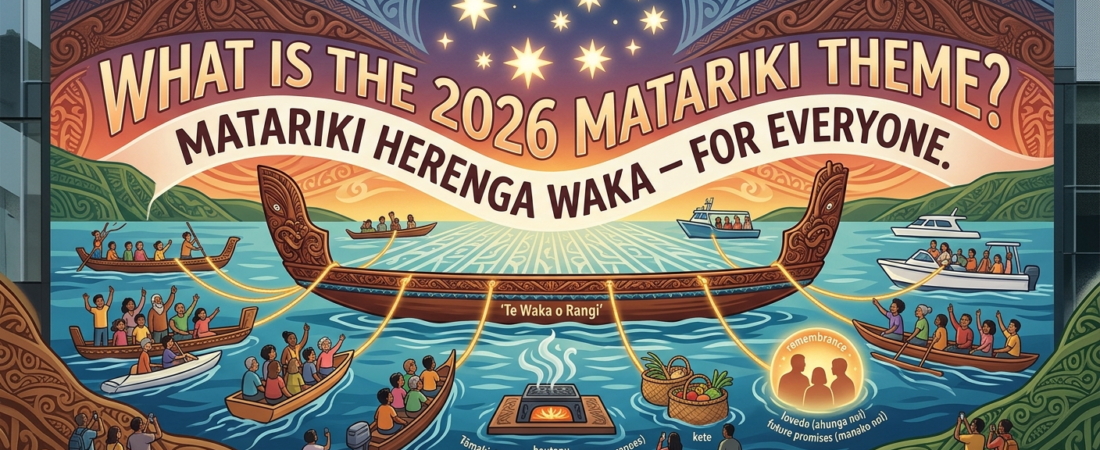
The theme for Matariki 2026 is Matariki herenga waka — a phrase that honours the waka (traditional Māori canoe) as a symbol of navigation, connection, and the courage to voyage into the unknown. The herenga waka theme recognises the extraordinary navigational knowledge of Māori ancestors who crossed the vast Pacific Ocean in waka hourua (double-hulled voyaging canoes) guided by the stars, the currents, the winds, and the patterns of the natural world — including Matariki itself, which served as one of the key navigational reference points for Pacific seafarers.
In the context of 2026, the herenga waka theme carries a significance that extends beyond historical commemoration. A waka requires collective effort to navigate — it cannot be paddled by one person alone, and it cannot reach its destination without everyone onboard working together with genuine commitment to the same direction. The theme is therefore both a celebration of ancestral skill and a contemporary invitation to navigate the present with the same qualities that made those ancient voyages possible: careful reading of the signs available, shared purpose, and the courage to set out even when the destination cannot yet be seen.
This theme sits in remarkable alignment with the numerological quality of the 2026 Matariki date itself — Friday 10 July 2026 reduces numerologically to 9 (the number of Mars, completion, collective service, and the courage to act for something larger than personal interest). The herenga waka theme and the numerological nine are describing the same essential quality from different cultural frameworks: the year’s Māori New Year is asking for collective courage and the willingness to navigate toward something meaningful together.

What Is the Lucky Number for Matariki?
The lucky number for Matariki is 9. This number is associated with positive energy, good fortune, collective wisdom and the completion of cycles — qualities that align precisely with what Matariki represents in both Māori tradition and in the Western Pythagorean numerological system. The number 9 is the most complete single digit in numerology, the only number that returns to itself when multiplied by any other number, and the number universally associated with the fulfilment of a cycle and the wisdom that comes from having moved through its full range of experience.
The lucky number 9 for Matariki is derived in two ways. The first is numerological — the name “Matariki” itself, when calculated using the Pythagorean system (M=4, A=1, T=2, A=1, R=9, I=9, K=2, I=9 → 4+1+2+1+9+9+2+9 = 37 → 3+7 = 10 → 1+0 = 1 for the Expression Number), gives an Expression Number of 1, indicating personal purpose, natural talents and the initiation of new cycles. The Lucky Number of 9, meanwhile, comes from the date of Matariki 2026 itself — 10 July 2026 reduces as 1+0+0+7+2+0+2+6 = 18 → 1+8 = 9. Together, the Expression Number 1 and the Lucky Number 9 describe the full arc of Matariki’s significance: the ending of one complete cycle (9) and the initiation of a new one with fresh purpose and direction (1).
The lucky colours traditionally associated with Matariki are gold and yellow — the colours of the Pleiades star cluster as seen in the pre-dawn sky, and the colours of new growth, warmth and the first light returning after the winter solstice. The lucky stone is sapphire — associated in gemological tradition with wisdom, good fortune, spiritual clarity and the capacity to navigate toward what is most meaningful. Together, the lucky number 9, the colours gold and yellow and the stone sapphire create a complete Matariki talisman for 2026: the completion of what has been, the warmth of what is returning and the clarity to set direction for what comes next.
Discover your personal lucky numbers for 2026 — including how your Life Path Number interacts with Matariki’s 9 energy — with the free Lucky Numbers Calculator.
Find Your Matariki Numbers
What Are the Nine Stars of Matariki and What Does Each One Mean?
In the knowledge system held by many Māori iwi (tribes), the Matariki cluster is understood as comprising nine named stars, each governing a specific domain of the natural world and human experience. This nine-star framework is the most cosmologically precise and personally relevant dimension of Matariki — and it is the aspect of the tradition that creates the most direct and meaningful connection between Matariki and the numerological and astrological frameworks that this site explores.
The nine stars and their domains are as follows, drawing on the te ao Māori (Māori worldview) knowledge system that has been shared in public education contexts by the New Zealand government and Māori cultural institutions.
Matariki is the mother star and the cluster’s governing presence, associated with the wellbeing of people and the health of the natural environment. She represents the overarching care and attentiveness that make all other domains flourish. In numerological terms, Matariki’s domain of wellbeing and environmental care corresponds to Venus — the governing planet of Life Path 6 and of the Celtic tree sign Vine. People with a strong Venus or Life Path 6 influence in their charts are particularly attuned to Matariki’s specific frequency.
Pōhutukawa is the star that connects the living with those who have passed away since the last Matariki. She receives the spirits of the dead and carries them to the heavens. Of all nine stars, Pōhutukawa carries the most overtly Saturnine and Plutonian energy — the energy of completion, of acknowledging endings, and of the specific form of wisdom that can only come from confronting mortality. Life Path 8 (Saturn) and Reed people in the Celtic zodiac (Pluto-governed) will find Pōhutukawa’s domain the most personally resonant.
Tupuānuku is the star governing food grown within the earth — the kūmara, the root vegetables, the crops that sustain the community through the winter months. Her energy is deeply grounded, patient, and oriented toward long-term nourishment. The correspondence with earth energy and the numerological four (Uranus/Rahu, structure, disciplined building) is direct: Life Path 4 people and those born under the Alder Celtic sign will feel particularly connected to Tupuānuku’s domain during Matariki.
Tupuārangi is the counterpart to Tupuānuku — the star governing food gathered from above and from the sea, including birds, berries, and the fruits of the ocean. She represents abundance that comes from the sky and the water rather than from the earth. Her energy is expansive, generous, and associated with the gifts that arrive rather than the ones that must be cultivated. This aligns with Jupiter’s expanding, abundance-generating energy and corresponds to Life Path 3 and the Celtic tree sign Oak.
Waitī is the star governing all freshwater environments — rivers, lakes, streams, and the creatures that inhabit them. She represents the flow of emotional life, the renewal that fresh water brings, and the specific quality of emotional intelligence that navigates by feeling rather than by map. The correspondence with the Moon’s governing energy is precise: Life Path 2 people and the Moon-governed Celtic signs Rowan and Willow will find Waitī particularly relevant to their Matariki practice.
Waitā is the counterpart to Waitī — governing saltwater environments, the ocean, and the resources the sea provides. Saltwater carries a different quality to freshwater: it is ancient, expansive, and governed by the Moon’s tides in a way that freshwater bodies are not. Waitā’s domain corresponds to the deep, boundary-dissolving energy of Neptune and aligns with Life Path 7 and the Celtic sign Ash.
Waipuna-ā-Rangi is the star governing rain and the connection between the sky and the earth — the water that falls from above to nourish what grows below. She represents communication between realms, the creative intelligence that translates inspiration into action, and the adaptability required to move between different states and conditions. Mercury’s governing energy — the planet of communication, adaptability, and the rapid processing of information — corresponds precisely to Waipuna-ā-Rangi’s domain. Life Path 5 people and those born under the Celtic signs Hawthorn or Hazel will find this star’s domain particularly active in their Matariki experience.
Ururangi is the star governing the winds — the invisible forces that carry messages, change conditions, and make navigation both possible and challenging. Wind in Māori cosmology is not merely a meteorological phenomenon but a carrier of ancestral communication and spiritual direction. Ururangi’s domain connects to Mercury’s messenger energy and, at a deeper level, to the Uranian principle of sudden change and breakthrough. Life Path 5 people share Mercury’s domain with this star, whilst Life Path 4 people (Uranus-governed) will recognise Ururangi’s quality of structural disruption that ultimately serves renewal.
Hiwa-i-te-rangi is known as the wishing star — the star specifically associated with aspirations, goals, and the intentions we set for the year ahead. She is the star of the future rather than the past, of what is possible rather than what has been, and of the solar courage required to begin. Hiwa-i-te-rangi corresponds to the Sun’s governing energy — the energy of Life Path 1, of the Celtic sign Birch, and of the pioneering initiative that initiates new cycles. On Matariki, it is traditional to make a wish or set an intention in Hiwa-i-te-rangi’s direction — a practice that is, in essence, a solar intention-setting ritual of the same kind that underpins all Life Path 1 and Sun-governed energy work.
What Is the Numerology of Matariki?
In Matariki numerology, the name “Matariki” is associated with the Pleiades star cluster, which holds significant cultural and astrological importance in Māori tradition. The Expression Number for “Matariki” is 1, indicating a focus on personal purpose, natural talents and the initiation of new cycles. This is calculated using the Pythagorean system: M(4)+A(1)+T(2)+A(1)+R(9)+I(9)+K(2)+I(9) = 37 → 3+7 = 10 → 1+0 = 1.
The number 1 as Matariki’s Expression Number is deeply consistent with what Matariki represents culturally: it is the number of the pioneer, the initiator and the individual who steps forward to lead a new direction. Matariki is the star that leads the cluster into the sky — the first to rise, the one from which the others take their direction. In Māori tradition, Matariki is the mother star — the governing presence from which all nine domains receive their coherence and direction. The numerological 1 and the cultural role of Matariki as the guiding star describe exactly the same quality from two different frameworks.
The Lucky Number for Matariki 2026 is 9 — derived from the date 10 July 2026 (1+7+1 = 9 after component reduction). The lucky colours are gold and yellow, and the lucky stone is sapphire. Together these elements create the complete numerological profile of Matariki 2026: Expression Number 1 (new purpose, initiative, leading) and Lucky Number 9 (completion, collective service, the full arc of experience). The 1 and the 9 together describe the threshold — the end of what has been and the beginning of what is possible.
The date of Matariki 2026 — Friday 10 July 2026 — carries a specific numerological quality that is striking in its alignment with the herenga waka theme. Reducing the date numerologically: the day is 10, which reduces to 1. The month is 7, which remains 7. The year 2026 reduces as 2+0+2+6 = 10, which reduces to 1. Adding these: 1 + 7 + 1 = 9.
The numerological quality of 10 July 2026 is nine — the number of Mars, the most magically complete number in both Celtic numerology and Māori numerical tradition, and the number associated with the completion of cycles, humanitarian service, and the courage to act for the benefit of the collective rather than for personal gain alone. This is precisely the quality that the herenga waka theme is calling for: nine is the number of the waka that has crossed the ocean, carrying its people through the full cycle of a voyage that required everything from everyone onboard, and arriving at a destination that benefits all rather than only one.
The nine-star structure of Matariki itself reflects this numerological completeness — nine domains, nine dimensions of the natural and human world, nine directions from which the Māori New Year asks for attention and gratitude. And the most magical number in Celtic numerology is also nine — the nine hazelnuts of wisdom, the nine sisters of Avalon — which means that across two of the world’s most ancient and unrelated astrological and cosmological traditions, the number nine marks the point of complete divine expression and the threshold of a new beginning.
Matariki 2026 · Explore More
Go Deeper Into Matariki 2026
Matariki 2026 falls on Friday 10 July. Discover what the nine stars mean, what your Life Path Number reveals for the year ahead, and which Celtic tree sign you carry — both traditions read the sky the same way.
Matariki 2026 Lucky Numbers — What Does This Year Hold for Your Life Path?
The universal lucky number for Matariki 2026 is 9 — but how that energy expresses itself in your specific life depends on your personal Life Path Number, the most foundational number in your numerological profile. Your Life Path Number is calculated from your full date of birth and reveals your core life direction, natural strengths and the specific way universal energies like the Matariki 9 interact with your personal numerological blueprint. The table below shows what Matariki 2026’s 9 energy means for each Life Path Number — what it is asking for, what it is completing and what your specific lucky focus is for the New Zealand year ahead.
| Life Path | Matariki 2026 Energy | Your Lucky Focus | Matariki Star |
|---|---|---|---|
| 1 | Final clearing before a major new beginning | Release and prepare — your next cycle is significant | Hiwa-i-te-rangi (the wishing star) |
| 2 | Relationship completions and deeper alignment | Resolve what is unfinished in partnerships | Waitī (freshwater — emotional flow) |
| 3 | Creative cycle completing — new expression incoming | Finish projects, share what you have built | Tupuārangi (abundance from above) |
| 4 | Structural review — what foundations to keep | Audit, consolidate, release what is not working | Tupuānuku (food from the earth) |
| 5 | Freedom from an old pattern or limiting situation | The change you have been sensing is ready now | Waipuna-ā-Rangi (rain — sky to earth) |
| 6 | Service cycle deepening — give with wisdom | Home, whānau and community are your lucky focus | Matariki (wellbeing of people) |
| 7 | Spiritual completion — major insight incoming | Trust your deepest knowing over external opinion | Waitā (saltwater — ancient wisdom) |
| 8 | Financial cycle review — harvest what you have built | Receive and consolidate — next cycle brings expansion | Pōhutukawa (remembrance & completion) |
| 9 | Double completion — one of your most significant years | Release fully. What ends now creates extraordinary space | Ururangi (winds of change) |
Don’t know your Life Path Number? The free Life Path Calculator gives you your number instantly from your date of birth — then come back to this table to find your specific Matariki 2026 energy and the star that governs your year ahead.
Matariki Guide · Date · Theme · Nine Stars
Matariki 2026 — Date, Theme and the Nine Stars Explained
Matariki 2026 falls on 10 July under the theme Matariki herenga waka — the ancestral art of navigation. Each of the nine named stars governs a specific domain of life. Discover what each star means, how Matariki connects to your zodiac sign, and how to mark the New Year with intention.
How Does Matariki Connect to Your Zodiac Sign?
Matariki falls on 10 July 2026 — which places it squarely within the Celtic tree sign of Oak (10 June to 7 July is Oak season, and by 10 July we are entering the Holly season, 8 July to 4 August). Holly is governed by Saturn, the planet of disciplined authority and long-term consequence, and the 2026 Matariki falling at the very beginning of the Holly season creates a precise alignment: the Māori New Year in 2026 arrives at the exact moment the Celtic calendar moves from the expansive wisdom of Oak (Jupiter) into the demanding, structured authority of Holly (Saturn). This transition point — from expansion into discipline, from growth into consolidation — describes 2026’s central astrological theme with unusual precision.
For Western zodiac signs, Matariki 2026 falls during Cancer season (21 June to 22 July). Cancer is the sign of home, family, emotional roots, and the specific form of nourishment that comes from belonging to something larger than the self — qualities that align naturally with Matariki’s themes of community, remembrance, and the setting of collective intentions for the year ahead. Cancer is governed by the Moon, and the Moon governs the tides that made Pacific navigation possible, the lunar calendar that determines when Matariki falls, and the emotional intelligence that Waitī and Waitā — the freshwater and saltwater stars — represent in Māori cosmological tradition.
Celtic Zodiac
Explore the Ancient Celtic System
13 lunar tree signs rooted in Druid wisdom — a completely different lens on your personality, numerology and astrology.
Why Is Matariki Celebrated in Winter in New Zealand?
This is one of the most commonly asked questions about Matariki, and it reflects the perspective of people in the Northern Hemisphere for whom the Pleiades rise in autumn rather than winter. New Zealand is in the Southern Hemisphere, where the seasons are the reverse of those in Europe, North America, and Asia. When it is winter in New Zealand (June–August), it is summer in the Northern Hemisphere — and when New Zealanders look up at the pre-dawn winter sky and see the Matariki star cluster rising above the horizon for the first time after its annual period of invisibility, they are observing the same astronomical event that Northern Hemisphere cultures have associated with autumn and the beginning of the harvest season.
For Māori, the midwinter rising of Matariki was specifically practical and spiritually significant. The crops had been harvested, the stores were set for the cold months, and the community had both the time and the reflective space that winter provides to look back at the year gone, to mourn those who had passed since the last rising, and to set intentions for the planting and growing season ahead. Winter is not, in the Māori worldview, a time of dormancy or waiting — it is a time of deliberate inner work that makes the outer work of the summer season possible.
This Southern Hemisphere framing is also relevant for New Zealanders who work with Western astrology and numerology. The standard seasonal associations used in Western astrological tradition — Aries as spring, Cancer as summer, Libra as autumn, Capricorn as winter — are reversed in the Southern Hemisphere. A New Zealander born on 10 July is, from a seasonal lived experience perspective, born in midwinter rather than midsummer, and this has genuine implications for how the solar arc of the year is experienced. Matariki, which honours the Southern Hemisphere’s actual seasonal reality, provides an astrological anchor that Northern Hemisphere-designed calendars do not.
How Should You Mark Matariki 2026?
The traditional Matariki observances involve three phases that map precisely onto the numerological and astrological themes of the date. The first phase is remembrance — acknowledging and honouring those who have passed since the last Matariki rising, speaking their names, and symbolically releasing them to Pōhutukawa’s care. The second phase is gratitude — giving thanks for the abundance that the earth, sea, sky, and community have provided through the year, and acknowledging the specific gifts of each of the nine stars’ domains. The third phase is intention — setting goals for the year ahead by directing wishes and aspirations toward Hiwa-i-te-rangi, the wishing star, and committing to the actions that will make those intentions real rather than merely desired.
From a numerological perspective, the three phases of Matariki mirror the three-stage structure of the most effective intention-setting practice in Western numerology: the release of what has been completed (Saturn/Life Path 8 energy), the acknowledgement of present abundance (Venus/Life Path 6 energy), and the setting of a solar intention for what is to be created (Sun/Life Path 1 energy). Matariki, understood numerologically, is a complete cycle of conscious creation condensed into a single observance.
For the complete guide to all thirteen Celtic tree signs, their governing planets, and what the ancient Druidic tradition reveals about personality and life purpose, visit the Celtic Zodiac Signs and Meanings guide. To explore how the numerological qualities of 2026 affect your specific life path number, visit the Celtic Astrology 2026 guide.
Your Matariki 2026 Personal Reading
What Do the Nine Stars of Matariki Reveal About Your Year Ahead?
Each of the nine Matariki stars governs a specific life domain and corresponds to a numerological energy. Your life path number and zodiac sign reveal which star is speaking most directly to you in 2026 — and what it is asking you to build, release, or begin.
Frequently Asked Questions
When is Matariki 2026?
Matariki 2026 will be observed on Friday 10 July 2026. This is the official New Zealand public holiday for the Māori New Year in 2026, falling on the Friday following the new moon that occurs after the Matariki star cluster’s first visible pre-dawn rising in the Southern Hemisphere winter sky.
Is Matariki 2026 a public holiday?
Yes — Matariki is an official New Zealand public holiday, established in 2022. It is the first new public holiday added to the New Zealand calendar in decades and the first in the world dedicated specifically to an indigenous astronomical event. Matariki 2026 falls on Friday 10 July, creating a long weekend.
What is the theme for Matariki 2026?
The theme for Matariki 2026 is Matariki herenga waka, which honours the waka (traditional Māori canoe) and the extraordinary navigational knowledge of Māori ancestors who voyaged across the Pacific Ocean guided by the stars. The theme celebrates collective navigation, ancestral wisdom, and the courage to set out toward a shared destination.
What are the nine stars of Matariki?
The nine named stars of Matariki are Matariki (wellbeing and environment), Pōhutukawa (those who have passed), Tupuānuku (food from the earth), Tupuārangi (food from above and the sea), Waitī (freshwater environments), Waitā (saltwater environments), Waipuna-ā-Rangi (rain and sky connection), Ururangi (winds), and Hiwa-i-te-rangi (the wishing star, aspirations and goals).
Why does the Matariki date change each year?
Matariki is aligned with the lunar calendar rather than the fixed solar calendar. It falls on the first Friday after the new moon that follows the Matariki star cluster’s heliacal rising — its first visible appearance above the horizon before sunrise after a period of invisibility. Because the lunar and solar calendars are not synchronised, this date shifts each year, falling somewhere in late June or early July.
What does Matariki mean in Māori?
Matariki has two widely recognised interpretations in te reo Māori. The first is Mata Ariki, meaning “eyes of god” — a reference to the star cluster’s role as a divine navigational and seasonal sign. The second is Mata Kī, meaning “tiny eyes” — an astronomical description of the cluster’s appearance. Both interpretations point to the same essential meaning: Matariki is a time of seeing, of reading the signs available in the natural world, and of using that reading to navigate the year ahead with wisdom and intention.
What number is Matariki 2026 in numerology?
The date of Matariki 2026 — 10 July 2026 — reduces numerologically to nine: the day (10) reduces to 1, the month (7) remains 7, and the year (2026 = 2+0+2+6) reduces to 1. Adding 1+7+1 gives 9. Nine is the most magically complete number in Māori numerical tradition as well as in Celtic numerology — the number of completion, collective service, and the courage to act for something larger than personal interest. This alignment between the date’s numerological quality and the 2026 herenga waka theme is precise: nine is the number of the waka that has completed its voyage, arriving with wisdom earned through the full commitment of everyone onboard.
How does Matariki relate to astrology?
Matariki falls in Cancer season in Western astrology and at the transition between the Celtic tree signs of Oak (Jupiter) and Holly (Saturn) in the Celtic zodiac — a transition from expansive wisdom into disciplined authority that describes the broader astrological quality of 2026 precisely. Cancer is governed by the Moon, which also governs the tides that made Pacific navigation possible and the lunar calendar that determines when Matariki falls each year. The nine stars of Matariki each correspond to a specific planetary energy and life path number, creating a complete astrological framework within the Māori cosmological tradition.
What Is the Lucky Number for Matariki?
The lucky number for Matariki is 9. This number is associated with positive energy, good fortune, completion and collective service across numerological traditions. The number 9 for Matariki 2026 is derived from the date of the official public holiday — 10 July 2026 — which reduces numerologically to 9 (1+0+0+7+2+0+2+6 = 18 → 1+8 = 9). The lucky colours for Matariki are gold and yellow, and the lucky stone is sapphire. The Expression Number for the name “Matariki” itself is 1 — indicating purpose, natural talents and the initiation of new beginnings.
What Is the Numerology of Matariki?
In numerology, the name “Matariki” has an Expression Number of 1 — calculated using the Pythagorean system where each letter converts to a number (M=4, A=1, T=2, A=1, R=9, I=9, K=2, I=9), totalling 37 which reduces to 10 and then to 1. The Expression Number 1 indicates personal purpose, natural talents and the energy of initiation — entirely consistent with Matariki’s role as the guiding mother star that leads the cluster into the sky and marks the beginning of the Māori New Year. The Lucky Number for Matariki 2026 specifically is 9, derived from the date 10 July 2026. Together, Expression Number 1 and Lucky Number 9 describe the full arc of Matariki: the completion of one cycle and the purposeful beginning of the next.
What Are the Lucky Colours for Matariki?
The lucky colours for Matariki are gold and yellow — the colours of the Pleiades star cluster as seen in the pre-dawn sky, and the colours traditionally associated with new growth, warmth and the return of light after the winter solstice in Aotearoa New Zealand. These colours are also associated with the number 9’s planetary ruler Mars in its positive expression — the warm, courageous energy of forward movement in service of something meaningful. Incorporating gold and yellow into your Matariki celebrations — through decorations, clothing, flowers or food — is a way of consciously aligning with the lucky frequency of the 2026 Māori New Year.
Recent Posts
- Venus in Libra: Love, Traits, Compatibility and Style
- Venus in Sagittarius: Love, Traits, Compatibility and Style
- Venus in Capricorn: Love, Traits, Compatibility and Style
- Venus in Scorpio: Love, Traits, Compatibility and Style
- What Your Moon Sign Reveals About Emotional Needs, Comfort, and Instincts