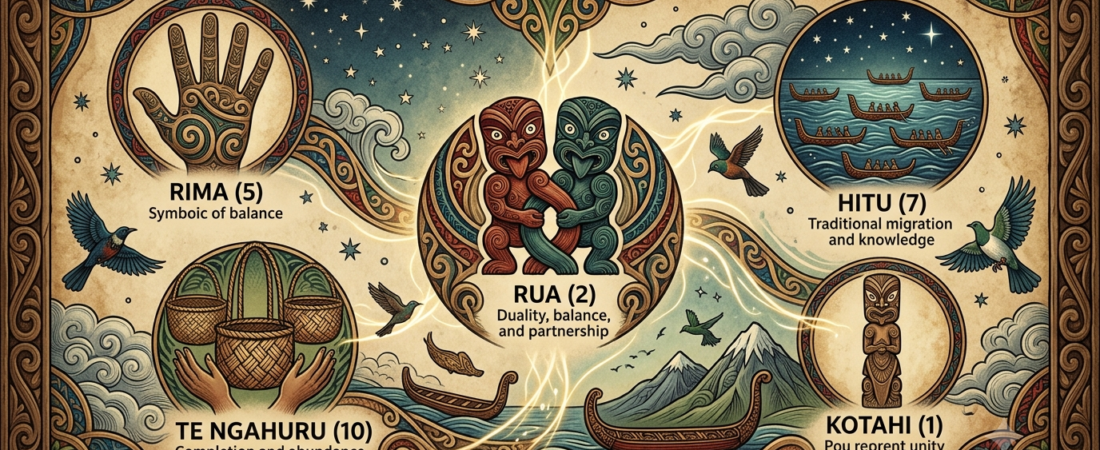
The sacred numbers in Māori culture are expressed through the concept of ngā tau — the numbers tahi (1) through iwa (9) — which carry deep cultural, cosmological and spiritual significance in Māori tradition, with the most revered being iwa (9), the number of the nine Matariki stars and the completeness of Te Iwa o Matariki, and whitu (7), which appears repeatedly in Māori stories and ceremonies as a number of sacred significance and spiritual power.
Most Sacred
Iwa (9) — Matariki stars
Spiritual Power
Whitu (7) — stories & ceremony
System
Decimal — Ngā Tau 1–10
Lunar Calendar
Maramataka
Core Concepts
Mauri, Mana, Tapu
Your Numbers
Numbers carry meaning in every culture that has developed a sophisticated relationship with the natural world — and in Māori culture, the relationship between number, cosmology and the living environment is one of the most holistically integrated in the Pacific world. The Māori number system — ngā tau — is not merely a counting tool. It is a framework for understanding relationship, completeness, cycles and the way the natural world organises itself into meaningful patterns that human beings can learn to read and to work with consciously.
For people with an existing knowledge of Western Pythagorean numerology — the tradition that underpins the calculators on this site — the sacred numbers of Māori culture offer a remarkable confirmation of numerology’s cross-cultural validity. The numbers that carry the most spiritual significance in Māori tradition are the same numbers that carry the most distinctive and well-defined energy in the Pythagorean system. The specific qualities attributed to iwa (9) in Māori cosmology — completeness, the wholeness of the nine-star framework, the honouring of what has passed and the readying for what comes next — are identical to the qualities that Pythagorean numerology attributes to the Life Path 9. This is not because one tradition borrowed from the other. It is because both traditions are reading the same underlying truth about how number and reality are organised.
This guide covers the sacred numbers of Māori culture in full — their te reo Māori names, their cultural significance, their role in Māori cosmology and ceremony and their resonance with Western Pythagorean numerological meanings. If you want to discover your own numerological profile and understand how it connects to the Māori number traditions covered here, the free Life Path Calculator gives you your core number instantly.
What Is the Role of Numbers in Māori Culture?
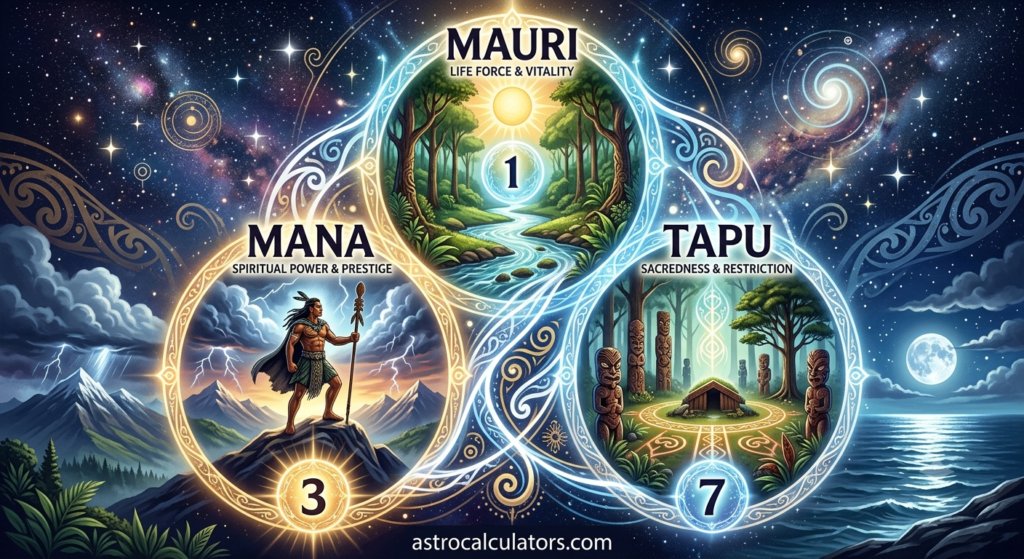
In Māori culture, numbers are not abstract quantities — they are expressions of relationship, pattern and the interconnectedness of all dimensions of existence. The Māori worldview understands reality as a web of relationships governed by three fundamental concepts: mauri (the life force that animates all living things), mana (the power, authority and prestige that accrues through right action and right relationship) and tapu (the sacredness and restriction that protects what is spiritually significant from depletion or misuse). Numbers participate in all three of these dimensions — certain numbers carry specific mauri qualities, specific numerical patterns express the proper ordering of mana, and certain numbers appear specifically in tapu contexts of ceremony, ritual and the sacred work of tohunga (expert practitioners).
The Māori counting system — ngā tau — is decimal in structure, built around the ten base numbers from tahi (1) through tekau (10). Research on pre-European Māori construction, architecture and oral history supports the presence of a developed decimal system in traditional Māori practice. But the significance of specific numbers in Māori culture goes far beyond their arithmetic function. The number seven — whitu — is significant in many Māori stories and is often considered a sacred number. The number nine — iwa — carries the deepest cosmological significance through its connection to Te Iwa o Matariki, the nine named stars of the Matariki cluster. And the number one — tahi — carries the specific quality of kotahi in ceremonial contexts, where it becomes “once and only once,” expressing the unique, irreplaceable quality of something that occurs exactly once in its fullness.
Numbers also appear throughout the maramataka — the traditional Māori lunar calendar — as organising principles for understanding time, cycle and the specific qualities of different phases of the lunar month. Each phase of the lunar cycle has a name and a set of activities that are considered most aligned with its energy. The maramataka does not use Western numerical designations for these phases — it uses descriptive names that encode the specific quality of each phase’s energy. But the underlying principle is the same as in numerological timing: different periods carry different qualities of energy, and aligning significant actions with supportive energetic periods produces better outcomes than acting against the grain of those cycles.
Ngā Tau — The Sacred Meaning of Each Number in Te Reo Māori
The ten base numbers of the Māori counting system — from tahi (1) through tekau (10) — each carry cultural, ceremonial and cosmological significance that resonates in striking ways with the energy that Western Pythagorean numerology attributes to the same numbers. The table below presents the complete picture: each number in te reo Māori, its pronunciation, its numerological energy in the Pythagorean system and its specific significance in Māori cultural tradition.
| Number | Te Reo Māori | Pronunciation | Pythagorean Energy | Māori Cultural Significance |
|---|---|---|---|---|
| 1 | Tahi / Kotahi | tah-hee / ko-tah-hee | Initiation, individual purpose, leadership | Kotahi — once and only once; the unique, irreplaceable singular. Used in ceremony to express the completeness of a single occurrence. Also expressed in the concept of kotahitanga — unity, the oneness of a people moving together. |
| 2 | Rua | roo-ah | Partnership, cooperation, balance | Rua also means “pit” or “cave” — the underground storehouse that preserves food through winter. Numerologically this aligns with 2’s energy of preservation, sustaining and the careful stewardship of what has been gathered. |
| 3 | Toru | toh-roo | Creative expression, communication, abundance | Three appears in fundamental Māori cosmological triads: the three baskets of knowledge (ngā kete wānanga) carried by Tāne from the heavens to humanity — Te Kete Tuauri, Te Kete Tuatea and Te Kete Aronui — containing the sacred knowledge of the spiritual, natural and human worlds. |
| 4 | Whā | fah (long a) | Foundation, structure, patient building | Four appears in the four cardinal directions that orient Māori spatial understanding — the four winds, the four pillars of the wharenui (meeting house) and the four phases of the human life cycle. The structural, foundational quality of 4 is expressed in Māori architecture and spatial organisation. |
| 5 | Rima | ree-mah | Freedom, change, adaptability, the senses | Rima also means “hand” in te reo Māori — the five-fingered hand that is the primary instrument of physical engagement with the world. The hand in Māori tradition is both practical and ceremonial: it builds, plants, harvests, weaves and performs karakia (ritual incantations). Five and hand share the quality of dynamic, multi-directional engagement. |
| 6 | Ono | oh-noh | Responsibility, care, service, harmony | Six appears in the traditional understanding of Matariki as a mother star and six daughters — the seven-star grouping visible to most eyes — before the full nine-star count was established as the authoritative Māori framework. The six daughters represent the domains of natural abundance that the mother star sustains and governs. |
| 7 | Whitu | fee-too | Spiritual depth, inner wisdom, seeking truth | Whitu is the most widely recognised sacred number in Māori stories and tradition. It appears across Māori oral literature as a number of spiritual significance, divine order and the completion of sacred tasks. The Pleiades — Matariki — was traditionally understood by many Pacific cultures, including some Māori iwi, as seven stars (the Seven Sisters), making whitu the number of the star cluster itself before the nine-star framework became authoritative. The sacredness of 7 in Māori tradition aligns precisely with 7’s quality in Pythagorean numerology as the number of spiritual depth, inner wisdom and the relentless pursuit of genuine understanding. |
| 8 | Waru | wah-roo | Material mastery, power, karmic abundance | Eight appears in the eight-day Arapiki — the rising period of Matariki when the star cluster is first visible above the horizon and the most powerful ceremonial and observational work takes place. The primary ritual involving the offering of food to the stars is best observed between July 7th and 9th at dawn, within the Arapiki window. The eight-day ceremonial window corresponds to 8’s energy of harvest, material acknowledgement and the proper honouring of what effort has produced. |
| 9 | Iwa | ee-wah | Completion, wisdom, humanitarian service | Iwa is the most cosmologically significant number in Māori tradition. Māori astronomy identifies nine distinct stars — Te Iwa o Matariki — each governing a specific environmental domain, and collectively predicting the abundance of the year ahead. The nine-star framework is the authoritative Māori understanding of the Matariki cluster, and the completeness of the nine domains — freshwater, saltwater, wind, rain, crops from earth, crops from sky, remembrance of the dead, wellbeing of people and aspirations for the future — represents the fullest possible expression of the natural world’s self-organising wisdom. Iwa as nine and iwa as completeness are the same word in te reo Māori. |
| 10 | Tekau | teh-kow | Return to 1 — new cycle at higher level | Tekau — ten — represents the completion of the base cycle and the beginning of a new order of magnitude. In Māori as in numerology, ten is not merely “one more than nine” — it is the threshold of a new scale of counting, the point at which the single-digit wisdom is ready to express itself in expanded form. |
Iwa — Why Nine Is the Most Sacred Number in Māori Cosmology
Of all the numbers in te reo Māori, iwa (9) carries the deepest cosmological significance — and the reason is directly connected to Te Iwa o Matariki, the nine named stars of the Matariki cluster that have governed the Māori New Year, the agricultural calendar and the ceremonial life of Aotearoa New Zealand for centuries. While Greek mythology references seven sisters, Māori astronomy identifies nine distinct stars — Te Iwa o Matariki — each governing a specific environmental domain, including freshwater, saltwater, winds, rain and crops, and collectively predicting the abundance of the year ahead.
The choice of nine as the authoritative count of the Matariki stars — rather than the seven that most other cultures use for the Pleiades — is itself a statement of cosmological completeness. The nine domains governed by Te Iwa o Matariki represent the full range of the natural world’s essential dimensions: the two water domains (freshwater Waitī and saltwater Waitā), the two weather domains (rain Waipuna-ā-Rangi and wind Ururangi), the two food domains (earth food Tupuānuku and sky food Tupuārangi), the human domain (wellbeing of people, Matariki), the ancestral domain (remembrance of the dead, Pōhutukawa) and the aspirational domain (intentions and wishes, Hiwa-i-te-rangi). The two stars often excluded in other cultures — Pōhutukawa and Hiwa-i-te-rangi — hold profound spiritual significance regarding life, death and aspirations, making the nine-star narrative essential to the complete Māori worldview.
In Western Pythagorean numerology, 9 is the number of completion, wisdom accumulated through the full range of human experience, and humanitarian service — the outward expression of that wisdom in contribution to others. The alignment between Māori iwa and Pythagorean 9 is precise: both understand this number as the one that contains within it the full range of what came before, and both understand its highest expression as service to the collective rather than accumulation for the individual. The nine Matariki stars governing nine domains of the natural world is, in numerological terms, the most complete possible expression of 9’s energy — the wisdom of the whole natural world organised into a nine-part framework that serves the entire community.
If your Life Path Number is 9, the Māori iwa tradition is speaking directly to your numerological nature. The full Life Path 9 guide explores what this number means for your personality, relationships, career and spiritual purpose in complete depth.
Whitu — The Sacred Power of Seven in Māori Tradition
While iwa (9) holds the most cosmologically significant position in Māori number tradition through its connection to Te Iwa o Matariki, whitu (7) carries what might be described as the most spiritually charged quality — the number that appears most consistently in Māori oral literature, ceremony and mythology as a signal of the divine, the sacred and the specifically spiritual dimension of what is being described. The number seven — whitu — is significant in many Māori stories and is often considered a sacred number.
The sacredness of 7 in Māori tradition reflects the same quality that makes 7 the most universally recognised sacred number across human cultures — it is the number that most consistently appears at the intersection of the human and the divine, the visible and the invisible, the known and the mysterious. In Māori cosmology, the seven-star reading of the Pleiades — understanding Matariki as a mother and six daughters — was widely held across Polynesia before the more authoritative nine-star framework became established as the complete Māori understanding. The seven-star Pleiades tradition is present in Greek mythology (Seven Sisters), in Japanese culture (Subaru — which means “to gather together” and depicts six stars, with the seventh implied), in Aboriginal Australian tradition, and across the Pacific. Māori tradition both honours this universal significance of 7 and transcends it with the fuller wisdom of the nine-star iwa framework.
In Pythagorean numerology, 7 is the number of spiritual depth, inner wisdom, the relentless pursuit of genuine understanding and the specific quality of knowing that comes from solitude, introspection and the willingness to look beneath the surface of things for the truth that is not immediately visible. The sacred quality of whitu in Māori stories is an expression of exactly this energy — 7 appears in Māori tradition specifically in contexts that carry a spiritual charge beyond the ordinary, where the visible world is being understood through the invisible patterns that govern it.
For people whose Life Path Number is 7, the Māori whitu tradition speaks directly to your numerological nature. Explore the complete profile at the Life Path 7 guide.
Toru — The Three Baskets of Knowledge and the Power of Three
The number three — toru — appears in one of the most fundamental narratives in Māori cosmology: the story of the three baskets of knowledge (ngā kete wānanga) that the god Tāne carried from the heavens to humanity. According to this tradition, Tāne ascended to the highest heavens — the twelfth heaven, Tikitiki-o-rangi — and brought back three sacred kete (baskets) containing the knowledge that human beings need to live with wisdom, purpose and right relationship to the natural world.
The three kete are Te Kete Tuauri (the basket containing knowledge of ritual, prayer and spiritual practice), Te Kete Tuatea (the basket containing knowledge of darkness, war, farming and all physical activity) and Te Kete Aronui (the basket containing the knowledge that humans use in their daily lives — the knowledge of peace, love, the arts and all the practices of civilised community living). These three baskets represent a complete framework for human knowledge — the spiritual dimension, the practical/physical dimension and the relational/cultural dimension. They are the three essential domains of human development that no person can be whole without.
In Pythagorean numerology, 3 is the number of creative expression, communication, joy and the abundance that arrives through genuine enthusiastic engagement with the world. The three baskets of knowledge in Māori tradition express this energy at its deepest level — the three domains of knowledge that the most creative, communicative and joyfully engaged human beings are drawing from simultaneously. The resonance between Māori toru and Pythagorean 3 is the resonance between creative wholeness and the completeness of a three-part framework that covers the full range of human development. Explore the Life Path 3 guide for the complete Pythagorean 3 profile.
Maramataka — The Māori Lunar Calendar and Numerological Timing
The maramataka — the traditional Māori lunar calendar — is one of the most sophisticated systems of time-based guidance in the Pacific world, and its underlying philosophy is remarkably consistent with the principles that govern numerological timing in the Western Pythagorean tradition. Both systems are built on the understanding that time is not neutral — that different periods carry different qualities of energy, and that aligning significant actions with supportive energetic periods produces better outcomes than acting against the grain of the prevailing cycle.
The Māori primarily measured time using natural and astronomical cycles, specifically through lunar phases. Their maramataka tracks the phases of the moon to determine activities and time. Each lunar phase has a name and is closely tied to agricultural and fishing practices. They had a cyclical way of timekeeping — natural phenomena linked to seasonal changes — rather than using fixed chronological units. This cyclical understanding of time — where the quality of each period is determined by its position within a larger cycle rather than its fixed position in a linear sequence — is the same understanding that underlies the Personal Year cycle in Western numerology, which also moves through nine phases, each with its own quality and specific guidance for what actions are most aligned with that period’s energy.
The convergence between maramataka and numerological timing is most clearly expressed at Matariki — the annual reset point where both systems identify the same period as the most powerful available for reflection, remembrance and intention-setting for the year ahead. The maramataka designates the period of Matariki’s rising as the most significant ceremonial and planning period of the year. Western numerology identifies the end of a nine-year cycle (a Personal Year 9) as the most significant completion and transition period available in the personal cycle. When these two timing systems are combined — the universal Matariki timing and the personal Personal Year timing — the result is the most complete framework available for New Zealanders who want to use their numerological profile for conscious, well-timed living.
To discover your current Personal Year Number and understand where you are in your nine-year cycle, the free Personal Year Calculator gives you your number instantly and explains what it means for your current twelve-month period.
Mauri, Mana and Tapu — The Three Sacred Principles and Number
The three foundational concepts of Māori cosmology — mauri, mana and tapu — are not numerical in themselves, but they operate through numerical frameworks in ways that illuminate the relationship between number and the sacred in Māori culture. Understanding how these three principles interact with number gives the deepest available picture of why certain numbers carry sacred significance in the Māori tradition.
Mauri — the life force that animates all living things — is understood in Māori tradition as a quality that can be sustained, depleted, damaged or restored through the quality of human action and relationship. Numbers that appear in contexts of mauri-protection and mauri-restoration — particularly iwa (9) in the context of the nine-star Matariki framework — carry the specific quality of mauri at the scale of the whole natural world. The nine domains of Te Iwa o Matariki are, in essence, the nine dimensions of mauri — the nine aspects of the natural world’s life force that together constitute the health and abundance of the whole system. When all nine are in balance, the mauri of the land, sea, sky and people is strong.
Mana — the power, authority and prestige that accrues through right action — is expressed numerically in Māori tradition through the concept of kotahi (the ceremonial form of tahi, one). Kotahitanga — unity — is the political and social expression of the number one’s energy at its highest development: the quality of a people or a group that has aligned itself so completely around a shared purpose that it moves as one. In Pythagorean numerology, this is the highest expression of the Life Path 1 — the individual who has developed their leadership and initiative capacity to the point where they can bring others into a unified forward movement rather than merely going ahead alone.
Tapu — the sacredness and restriction that protects what is spiritually significant — is expressed through specific numbers in Māori ceremonial tradition. The number seven (whitu) appears most frequently in tapu contexts — in chants, in the number of repetitions of ritual actions and in the structuring of ceremonies where the boundary between the ordinary world and the sacred dimension is being consciously maintained. The sacredness of 7 in Māori tapu contexts is the cultural expression of the same quality that makes 7 the most universally spiritually significant number in every major wisdom tradition — its position between the material world (1–6) and the completion of the cycle (8–9) makes it the number of the threshold, the point at which the ordinary becomes sacred.
Celtic Zodiac
Explore the Ancient Celtic System
13 lunar tree signs rooted in Druid wisdom — a completely different lens on your personality, numerology and astrology.
Your Life Path Number in Te Reo Māori
Understanding your Life Path Number in the context of the Māori number tradition adds a specifically New Zealand cultural dimension to your personal numerological profile. The table below gives you your Life Path Number’s te reo Māori name, its Māori cultural significance and the specific dimension of the Māori cosmological framework it most directly connects you to.
| LP Number | Te Reo Name | Māori Connection | Matariki Star |
|---|---|---|---|
| 1 | Tahi / Kotahi | Kotahitanga — unity, the unique singular, the leader who brings others into shared purpose | Hiwa-i-te-rangi — the wishing star, aspirations |
| 2 | Rua | The rua — the underground storehouse that preserves and sustains; the keeper of what is precious | Waitī — freshwater, emotional nourishment |
| 3 | Toru | Ngā kete wānanga — the three baskets of knowledge; the creative communicator who carries wisdom between worlds | Tupuārangi — abundance from above, Jupiterian gifts |
| 4 | Whā | The four directions, the four pillars of the wharenui — the builder of structures that shelter and orient the community | Tupuānuku — food from the earth, patient foundations |
| 5 | Rima | The hand — rima — the five-fingered instrument of active engagement with the world; the one who builds, plants and creates through direct contact | Waipuna-ā-Rangi — rain, the sky-to-earth change-bringer |
| 6 | Ono | The six daughters of Matariki — the sustainer of the domains that feed and nourish the community through service and care | Matariki — wellbeing of people, the mother star |
| 7 | Whitu | Sacred in Māori stories — the spiritual seeker, the one who moves between the visible and invisible worlds with genuine depth of understanding | Waitā — saltwater, ancient and oceanic wisdom |
| 8 | Waru | The eight-day Arapiki — the rising period of Matariki when the harvest of the year is ceremonially acknowledged and the abundance of effort is properly honoured | Pōhutukawa — remembrance, karmic completion |
| 9 | Iwa | Te Iwa o Matariki — the nine stars that together constitute the complete wisdom of the natural world; the one who embodies the full range of human experience in service of the collective | Ururangi — winds of change, the invisible force of renewal |
Discover your complete numerological profile — and understand which Māori number tradition speaks most directly to your personal nature — with the free Life Path Calculator. For your lucky numbers in the Māori New Year context, the free Lucky Numbers Calculator gives you your complete personal profile.
Frequently Asked Questions — Sacred Numbers in Māori Culture
What Are the Sacred Numbers in Māori Culture?
The most sacred numbers in Māori culture are iwa (9) and whitu (7). Iwa carries the deepest cosmological significance through its connection to Te Iwa o Matariki — the nine named stars of the Matariki cluster that together govern the nine essential domains of the natural world and provide the framework for the Māori New Year. Whitu is the most widely recognised sacred number in Māori oral tradition, appearing consistently in stories and ceremonies as a number of spiritual significance and divine order. The number tahi (1) carries sacred significance through the concept of kotahitanga — unity and the unique completeness of something occurring exactly once in its fullness. And toru (3) appears in the foundational story of the three baskets of knowledge brought by Tāne from the heavens.
What Is the Māori Word for Nine?
The Māori word for nine is iwa — pronounced ee-wah. Iwa is the most cosmologically significant number in te reo Māori through its connection to Te Iwa o Matariki — the nine named stars of the Matariki cluster. In traditional Māori understanding, iwa is the number of completeness — the nine domains governed by the Matariki stars represent the full range of the natural world’s essential dimensions, and nine as a number carries the quality of wholeness, the completion of a cycle and the wisdom that comes from having moved through the full sequence of experience from tahi to iwa.
What Is the Māori Word for Seven?
The Māori word for seven is whitu — pronounced fee-too (the wh in te reo Māori is pronounced as an f sound). Whitu is the most consistently sacred number in Māori oral literature and ceremonial tradition, appearing in stories and rituals as a number of spiritual significance and divine order. The sacredness of seven in Māori tradition aligns with its universally sacred status across human cultures — it is the number most consistently associated with the threshold between the ordinary and the sacred, between the visible world and the invisible patterns that govern it.
How Do Māori Numbers Connect to Western Numerology?
The connection between Māori numbers and Western Pythagorean numerology is not a case of one tradition borrowing from the other — it is a case of two traditions independently arriving at the same understanding of the qualities that different numbers carry. The most striking correspondences are iwa (9) and Pythagorean 9 — both understand this number as completeness, the wisdom of the full range of experience and the quality of humanitarian service that this wisdom enables; whitu (7) and Pythagorean 7 — both understand this number as the spiritually charged threshold between the visible and invisible; and tahi/kotahi (1) with Pythagorean 1 — both understand this number as the unique individual whose leadership brings others into unified forward movement. The Western Pythagorean Life Path Number — calculated from your date of birth — gives you your personal connection to this shared number wisdom.
What Is the Significance of Nine Stars in Matariki?
The nine stars of Matariki — Te Iwa o Matariki — are significant because they represent a complete cosmological framework for the natural world. Each of the nine named stars governs a specific environmental domain: Matariki (wellbeing of people), Pōhutukawa (remembrance of those who have passed), Waitī (freshwater environments), Waitā (saltwater and the ocean), Waipuna-ā-Rangi (rain), Ururangi (winds), Tupuānuku (food grown in the earth), Tupuārangi (food gathered from above) and Hiwa-i-te-rangi (aspirations and intentions for the year ahead). Together these nine domains cover the complete range of the natural world’s essential dimensions — making nine the number of natural completeness in Māori cosmology.
What Is Maramataka in Māori Culture?
Maramataka — literally meaning “the turning of the moon” — is the traditional Māori lunar calendar that tracks the phases of the moon to guide agricultural, fishing and ceremonial activities. Each phase of the lunar month has a name and a set of activities that are considered most aligned with its energy. The maramataka is a sophisticated system of timing guidance built on the understanding that different periods carry different qualities of energy — the same underlying philosophy that governs numerological timing in the Western Pythagorean tradition. At the level of the annual cycle, Matariki’s rising in late June to mid-July marks the most significant reset point in the maramataka — the moment when the new year begins and the cycle of intention-setting, effort and harvest begins again.
Angel Numbers
Explore Every Angel Number in Detail
Each angel number carries a unique spiritual message. Find your number below for the complete guide — meaning, love, twin flame, career and what to do when you see it.
Master Numbers
3-Digit Angel Numbers
4-Digit Angel Numbers
✨ Find Your Personal Angel Number FreeRecent Posts
- Venus in Libra: Love, Traits, Compatibility and Style
- Venus in Sagittarius: Love, Traits, Compatibility and Style
- Venus in Capricorn: Love, Traits, Compatibility and Style
- Venus in Scorpio: Love, Traits, Compatibility and Style
- What Your Moon Sign Reveals About Emotional Needs, Comfort, and Instincts