Celtic numerology is the ancient Druidic system of number symbolism rooted in Irish, Scottish, and Welsh tradition. Unlike Western Pythagorean numerology — which assigns personality traits to birth date calculations — Celtic numerology treats numbers as cosmological forces: expressions of the three realms, the sacred cycles, and the divine patterns woven into the natural world. The most sacred numbers in the Celtic system are 3, 7, 9, and 13, each governing a specific dimension of the Druidic worldview. These numbers are also encoded in the Ogham alphabet — the ancient Irish tree-script — where every letter, and every Celtic zodiac sign, carries a numerical position that bridges the tree calendar and the numerological tradition.
What Is Celtic Numerology?
Celtic numerology is the system of number symbolism developed within the Druidic tradition of ancient Ireland, Scotland, and Wales — a tradition in which numbers were never merely quantities but cosmological forces expressing the divine patterns woven through all of existence. The Druids, who were the priestly, scholarly, and judicial class of Celtic civilisation, understood the universe as fundamentally structured by specific numerical relationships: the Three Realms, the Nine Hazelnuts of Wisdom, the Thirteen Lunar Months, and the Five Great Festivals that organised the Celtic year. Every significant number in the Celtic worldview corresponded to a specific dimension of that worldview’s understanding of reality.
This is the foundational difference between Celtic numerology and the Western Pythagorean numerology most people are familiar with today. Western numerology — the system that calculates your life path number, birth number, and name number from your date of birth — is primarily a personality and destiny system: it tells you what kind of person you are and what your life is likely to be about. Celtic numerology is primarily a cosmological system: it tells you how the universe is organised, which forces are at work in any given situation, and how the invisible patterns beneath the visible surface of life can be read and worked with. The two systems are not contradictory — they are complementary lenses on the same underlying truth that numbers carry meaning far beyond their function as measures of quantity.
Celtic numerology is encoded most precisely in the Ogham alphabet — the ancient Irish tree-script in which every letter represents a sacred tree, and every tree occupies a specific numerical position within the alphabet’s four groups of five letters. This Ogham numerical structure is the direct ancestor of the Celtic tree zodiac, and it creates a precise bridge between Celtic number symbolism and the planetary ruler system that governs the thirteen Celtic zodiac signs.
Why Is Numerology Important in Celtic Culture?
Numerology was important in Celtic culture because the Druids understood the cosmos as a fundamentally mathematical structure — not in the abstract, quantitative sense of modern mathematics, but in the qualitative sense of specific numbers expressing specific divine realities. A Druid who understood the significance of the number three did not merely know that three things could be listed together; they understood that the pattern of three expressed the fundamental triadic structure of reality itself — the tension, resolution, and synthesis that underlies every natural cycle, every human relationship, every mythological narrative, and every spiritual teaching.
This cosmological understanding of number was expressed practically in Celtic culture in several distinct ways. The Celtic Triad — the literary form in which three related ideas are presented together as a single unit of wisdom — is the most visible expression of the number three’s sacred status. Triads appear throughout Irish and Welsh mythology as the primary vehicle for the transmission of wisdom, ethical teaching, and practical knowledge. The number nine appeared in the most significant moments of Celtic mythological narrative: nine hazelnuts in the Well of Knowledge, nine sisters of Avalon, nine feats of Cu Chulainn, nine waves of the sea. The number thirteen structured the entire Celtic calendar. And the number seven organised the seven-year cycles that appear repeatedly in Irish fairy tales and mythological time — the seven years a mortal might spend in the Otherworld, the seven-year intervals between great events.
Numbers in Celtic culture were not symbols of abstract truth. They were the actual structure of the living, intelligent universe expressing itself through the patterns of nature, myth, and human experience.
What Numbers Were Important to Celtic Culture?
The Celtic tradition assigned specific cosmological significance to several numbers above all others, and understanding these numbers gives access to the deepest structural logic of the Druidic worldview.
The number three is the most sacred number in all of Celtic culture, and its significance permeates every dimension of the tradition. The Three Realms — land, sea, and sky — constitute the entire physical universe in the Celtic cosmological framework. The Triple Goddess — Maiden, Mother, and Crone — expresses the complete cycle of feminine divine power. The three worlds of Celtic cosmology — the upper world of the divine, the middle world of human experience, and the lower world of ancestral wisdom — organise the entire invisible landscape that the Druids navigated. The Celtic Triad organises wisdom into three-part units because three is not merely a convenient grouping — it is the minimum number of elements required to create genuine dynamic relationship rather than static opposition. Two things oppose each other; three things create a field of interaction within which something genuinely new can emerge.
The number seven holds a specific quality of magic and threshold in Celtic tradition. Seven years is the standard unit of enchantment in Irish mythology — the period for which a mortal might be held in the Otherworld, transformed into another form, or subjected to a geis (magical obligation). The number seven represents the quality of deep immersion in a reality beyond the ordinary, and it appears wherever Celtic myth signals that ordinary rules of time and causality have been suspended.
The number nine is the most potently magical number in the Celtic tradition — the cube of three, the number that represents the completion of the sacred triad’s own tripling. The nine hazelnuts of wisdom that fell into the Well of Knowledge represent the complete accumulation of all possible wisdom. The nine sisters of Avalon represent the complete expression of healing and prophetic power. In Celtic cosmological thinking, nine represents the point at which a divine pattern has expressed itself completely and a new cycle is ready to begin.
The number thirteen is the structural number of the Celtic lunar calendar — the thirteen full moons within a solar year, each governed by a sacred tree of the Ogham alphabet. Thirteen is not an unlucky number in the Celtic tradition: it is the number of completion within the lunar system, the count of a full year of natural, cyclical wisdom. The fact that Western culture has made thirteen unlucky is, in part, a reflection of the suppression of the lunar, nature-based worldview that the Celtic tradition represents.
The number four organises the Celtic seasonal year through the Four Great Festivals: Samhain, Imbolc, Beltane, and Lughnasadh. These four points mark the turning of the year with ritual, myth, and the acknowledgement that time itself moves in a sacred fourfold pattern. The number four in Celtic culture is associated with groundedness, structure, and the honouring of natural cycles — qualities that align precisely with the numerological Life Path 4’s governing energy of Uranus and disciplined structure.
The number five marks the five provinces of ancient Ireland — Ulster, Munster, Leinster, Connacht, and the sacred central province of Meath — and the five sacred trees that served as the spiritual poles of the Irish landscape. Five in the Celtic tradition represents the fullness of a particular domain: the complete expression of a geographic, spiritual, or symbolic territory
What Is the Meaning of Each Number in Celtic Numerology?
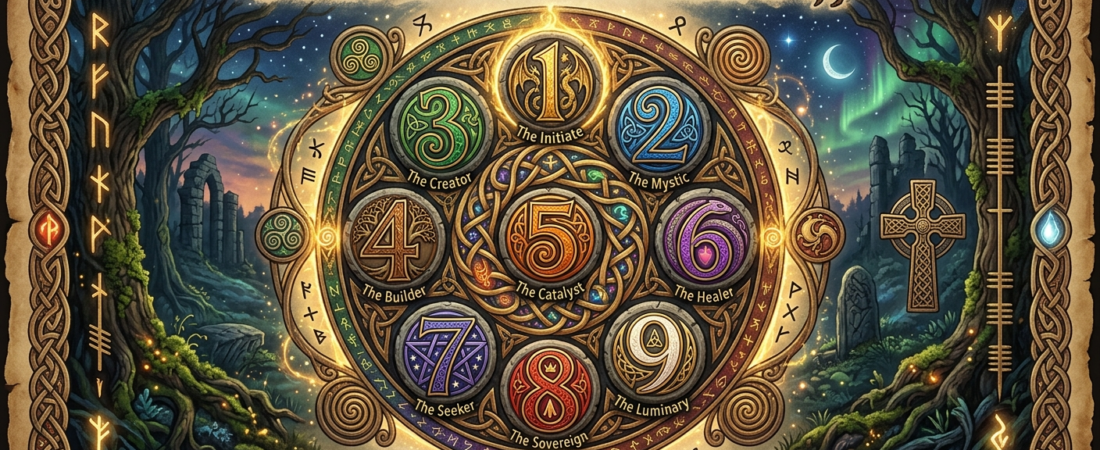
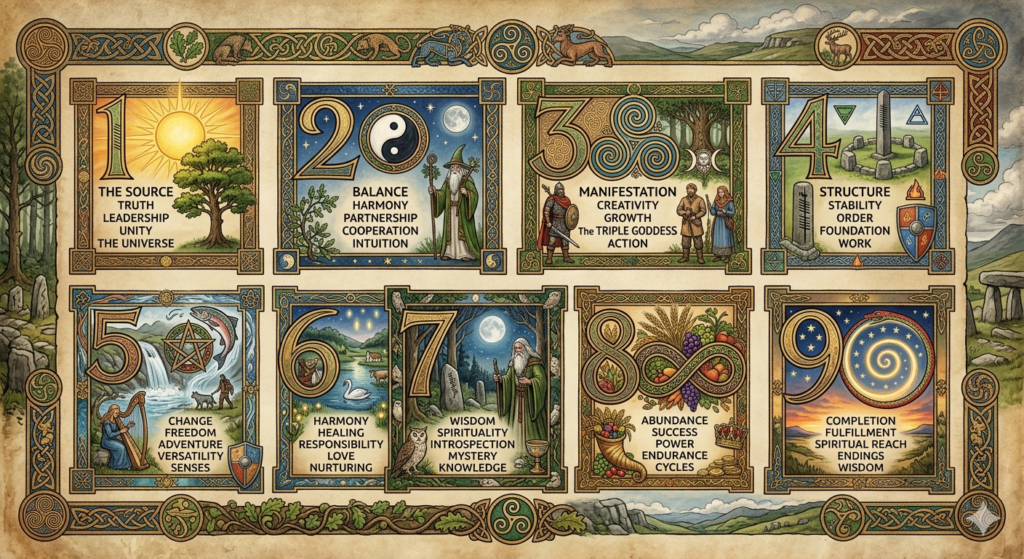
Celtic numerology assigns a specific quality to each of the numbers one through nine that both parallels and enriches the meanings found in Western life path numerology. Understanding both systems together creates a more complete picture of any number’s significance than either tradition provides alone.
One represents the undivided unity that precedes all manifestation — the point from which all patterns emerge. In Celtic cosmology, one is associated with the divine source before it has differentiated into the three realms. In Western numerology, Life Path 1 is governed by the Sun, the centre from which all else radiates. The correspondence is precise: one is the Sun, the source, the origin of individual consciousness and purposeful initiative.
Two represents the first division — the point at which unity becomes relationship, and relationship becomes the possibility of knowledge. The Celts understood duality not as opposition but as the necessary precondition for awareness: you cannot know warmth without cold, light without dark, self without other. Two in Celtic numerology is governed by the Moon, and it corresponds directly to Life Path 2’s Lunar energy of emotional intelligence, diplomacy, and the wisdom that comes from genuine partnership.
Three is, as established, the most sacred number — the point at which relationship becomes dynamic interaction and something genuinely new can emerge. In Celtic cosmology, three is the number of Jupiter’s expansive, creative, wisdom-generating energy. Life Path 3 is also governed by Jupiter, and the correspondence between Celtic sacred three and numerological Life Path 3’s gift for creative expression, generous intelligence, and the ability to bring ideas into vivid, living form is among the most elegant convergences between the two systems.
Four is the number of the four Celtic festivals and the four elements — Fire, Water, Earth, and Air — that the Druids understood as the constituent forces of the physical world. Four in Celtic tradition is associated with the groundedness, structural intelligence, and patient building that correspond precisely to Life Path 4’s governing energy of Uranus and Rahu: the disciplined architect who builds what endures.
Five is the number of the five provinces and the five sacred trees, carrying a quality of adventurous exploration across a complete territory. In Celtic tradition, five represents the full range of a landscape or domain fully traversed. Mercury governs both Celtic five and Life Path 5 — the number of adaptability, communication, freedom, and the curious intelligence that must experience widely before it can understand deeply.
Six is the number of harmony, responsibility, and the nurturing intelligence that holds a community together. In Celtic culture, the number six appears in the six-pointed patterns of Celtic knotwork as the expression of the interconnectedness between the three realms above and the three realms below. Venus governs six in Celtic numerology as in Western numerology, and Life Path 6 people carry the Venusian gift of care, beauty, and genuine service that makes them the sustainers of every community they enter.
Seven is the number of deep immersion, hidden wisdom, and the intelligence that operates beyond ordinary time. Neptune and its counterpart Ketu govern the mystical seven, and Life Path 7 people carry exactly the quality that Celtic tradition associates with seven-year enchantments: a depth of perception that functions in the invisible dimensions of reality that most people cannot access. The Hazel tree — occupying the ninth position in the Ogham alphabet but governed by Mercury’s intellectual depth — and Ash, governed by Neptune, both carry aspects of this seven-quality wisdom.
Eight is the number of structured power, material authority, and the long-term consequence of disciplined effort. Saturn governs eight in both systems, and the Celtic signs governed by Saturn — Holly, Ivy, and Elder — all carry aspects of this eight-quality: the specific form of strength that is built through sustained, serious, disciplined engagement with what genuinely matters.
Nine is the most complete number in Celtic numerology — the number of fully expressed divine potential, the end of the cycle that contains within it the seed of the next. Mars governs nine in both Celtic and Western numerology, and the quality of nine — completion, humanitarian breadth, the courage to serve something larger than the self — corresponds precisely to Life Path 9’s governing energy and to the Celtic tradition’s most magically significant number.
This nine-quality is not unique to the Celtic tradition. In Māori cosmological knowledge, the nine named stars of the Matariki cluster each govern a specific domain of the natural and human world — a framework that mirrors the Celtic nine’s quality of complete, multi-dimensional divine expression with remarkable precision. The guide to Matariki and the nine stars of the Māori New Year explores this parallel in full.
How Does Celtic Numerology Connect to the Celtic Tree Calendar?
The most distinctive and, in modern Celtic studies, least explored aspect of Celtic numerology is its direct structural relationship with the Ogham alphabet and the tree calendar it encodes. Each of the twenty original Ogham letters — feda, in Irish — occupies a specific numerical position within the alphabet’s four groups of five. The first group of five trees (Aicme Beithe) carries positions one through five. The second group (Aicme hÚatha) carries six through ten. The third group (Aicme Muine) covers eleven through fifteen. And the fourth group (Aicme Ailme) encompasses sixteen through twenty.
This means that every Celtic tree sign carries an Ogham numerical position — and that position carries its own layer of meaning within the Celtic numerological framework. Birch (Beith) occupies position one — the number of new beginnings, solar initiative, and the pioneering impulse to start. Rowan (Luis) occupies position two — the number of Moon-governed intuition and relational wisdom. Ash (Nion) occupies position five — Mercury and Neptune in convergence, the imaginative intelligence that moves fluidly between worlds. Oak (Duir) occupies position seven — the number of deep wisdom and hidden knowledge, perfectly aligned with Jupiter’s expansive intelligence. And Hazel (Coll) occupies position nine — the most sacred Celtic number, the completion number, assigned to the tree whose spirit animal is the Salmon of All-Knowledge and whose mythology is the most directly numerologically significant in the entire tradition.
This correspondence between Ogham numerical position and numerological meaning is not coincidental — it is the structural expression of a single underlying cosmological framework that the Druids encoded simultaneously in their alphabet, their calendar, their mythology, and their number symbolism. Understanding your Celtic tree sign’s Ogham position gives you an additional layer of numerological self-knowledge that no other system provides. To find your Celtic tree sign and its Ogham letter, use the free Celtic Zodiac Sign Calculator.
Celtic Astrology
Is your Celtic Tree Sign the Oak — The Druid’s Most Sacred Tree?
Born between June 10 and July 7? The Oak is your Celtic lunar sign — governed by Jupiter, symbolised by the White Horse and associated with sovereignty, natural authority and the power to carry others. The ancient Druids considered the Oak the most sacred of all trees.
What Are the Master Numbers in Celtic Numerology?
The concept of master numbers in numerology — numbers that are not reduced to a single digit because their doubled-digit energy carries a specific and amplified significance — has a direct parallel in Celtic tradition, though the Celtic framework expresses it differently.
The number eleven appears in Celtic tradition as the number that lies beyond the complete cycle of ten — a threshold number, carrying the quality of what exists at the boundary between the ordinary and the extraordinary. In Irish mythology, the eleventh hour is the liminal moment. Eleven in Celtic numerology shares the quality of its Western equivalent, Life Path 11: the intuitive messenger who perceives what others cannot and whose greatest challenge is the gap between that perception and its expression.
The number twenty-two is the complete Ogham alphabet — twenty original letters plus the two supplementary letters added later, bringing the total to twenty-two. Twenty-two in both Celtic and Western tradition represents the most complete structural expression of a system’s total knowledge. Life Path 22, the Master Builder of Western numerology, shares the Celtic twenty-two’s quality of comprehensive structural wisdom: the capacity to take the full range of available knowledge and build something with it that extends beyond the individual lifetime into genuine permanence.
The number thirty-three, whilst not specifically prominent in the Ogham structure, appears in Celtic tradition as the age at which the most significant mythological transformations tend to occur — the age of Cu Chulainn’s death, the threshold at which mortal power and divine consequence converge. The Celtic thirty-three carries the same quality as Life Path 33 in Western numerology: the Master Teacher whose wisdom has been tested by living and whose teaching is therefore not theoretical but genuinely transformative
How Does Celtic Numerology Connect to Life Path Numbers?
The convergence between Celtic numerology and Western life path numerology is most precisely expressed through the shared planetary rulerships that both systems assign to their key numbers. When the same planet governs both a Celtic number’s sacred quality and a Western life path number’s character profile, the two systems are pointing at the same underlying reality from different cultural and methodological directions.
The most significant convergences are these. Celtic three and Life Path 3 are both governed by Jupiter — and both describe the same quality of creative intelligence, generous expansion, and the ability to illuminate through expression. Celtic nine and Life Path 9 are both governed by Mars — and both describe the completion of a cycle, the courage to serve what transcends personal interest, and the specific power of an individual whose development has brought them to the point of genuine humanitarian contribution. Celtic seven and Life Path 7 are both governed by Neptune — and both describe the deep, searching, spiritually perceptive quality of someone who has chosen to understand what is real rather than what is comfortable
Sacred number systems appear across nearly every ancestral tradition — the Druidic system explored here shares striking parallels with the numerical cosmology of Aotearoa New Zealand. For another rich cultural lens on sacred numbers, see our guide to Sacred Numbers in Māori Culture, where iwa (nine) and whitu (seven) carry a spiritual weight remarkably similar to their Pythagorean meanings.
Life Path and Money Series
Explore Every Life Path Number and Money
Each Life Path Number has a completely different relationship with wealth, spending and financial purpose. Find your number’s specific money profile below.
The Meaning of Matching Planetary Energy in Celtic Astrology and Numerology
When your Celtic tree sign’s governing planet and your Western life path number’s governing planet are the same, both systems are identifying the same dominant force in your character from different directions. An Oak person (Jupiter-governed) who is also a Life Path 3 (Jupiter-governed) carries one of the most clearly Jupiter-aligned personalities in either tradition — expansive, wise, principled, and gifted at making others feel more capable and more seen. A Vine person (Venus-governed) who is also a Life Path 6 (Venus-governed) carries a double Venusian signature of beauty, care, harmony, and the specific nurturing intelligence that creates genuine community wherever it is directed.
To find your life path number and explore how it relates to your Celtic tree sign, use the free Life Path Number Calculator. For the complete guide to all thirteen Celtic tree signs, their governing planets, Ogham positions, and spirit animals, visit the Celtic Zodiac Signs and Meanings guide.To find your Celtic zodiac sign from your date of birth, use the free Celtic Zodiac Sign Calculator.
Celtic Tree Astrology · Star Calendar Connection
Matariki & the Celtic Zodiac — Both Read the Sky the Same Way
Matariki tracks the Pleiades rising to mark the New Year. The Celtic zodiac tracks the lunar year through 13 sacred trees — each governing a month with its own energy, gifts and shadow. Both traditions use celestial cycles to reveal your nature. Matariki 2026 falls directly inside Oak season — the Celtic tree of strength, leadership and the doorway between old and new.
Matariki 2026 falls in Oak season · 8 Jul – 4 Aug
The Oak is the protector and the doorway keeper — the Celtic tree that governs the threshold between the old year and the new. Oak people are natural leaders who carry others through transitions. Matariki 2026 landing in Oak season amplifies the universal 9 completion energy: the strength to release what has been and the courage to navigate what comes next.
Frequently Asked Questions
Why is numerology important in Celtic culture?
Numerology is important in Celtic culture because the Druids understood numbers not as abstract quantities but as cosmological forces — specific expressions of the divine patterns structuring reality. Numbers like three, seven, nine, and thirteen appear throughout Celtic mythology, ritual, and philosophy as markers of sacred significance, not arbitrary groupings. The Celts embedded their numerical understanding in the Ogham alphabet, the Celtic tree calendar, and the structure of their greatest myths, making number symbolism inseparable from their entire worldview.
What numbers were important to Celtic culture?
The most important numbers in Celtic culture were three (the most sacred, governing the Triple Goddess, three realms, and Celtic Triads), nine (the most magical, associated with complete divine expression and the nine hazelnuts of wisdom), thirteen (the number of the Celtic lunar calendar’s months and tree signs), seven (associated with enchantment, threshold, and the deep immersion of mythological time), and four (governing the four seasonal festivals and four elements). The number five was also significant as the number of the five Irish provinces and the five sacred trees.
What does the number 3 mean in Celtic numerology?
In Celtic numerology, the number three is the most sacred number in the entire tradition. It represents the Triple Goddess (Maiden, Mother, Crone), the Three Realms (land, sea, sky), and the three worlds of Celtic cosmology (upper, middle, lower). The Celtic Triad — the literary form used to transmit the most important Druidic wisdom — is itself a numerical expression of three’s sacred status. Three is governed by Jupiter in both Celtic and Western numerology and corresponds to Life Path 3’s gifts of creative expression, generosity, and illuminating intelligence.
What is the luckiest number in Celtic numerology?
In Celtic numerology, nine is considered the most auspicious and magically potent number. Nine represents the complete expression of divine potential — the cube of the sacred number three — and it appears in Celtic mythology at the most significant moments of transformation and enlightenment: the nine hazelnuts of all-world wisdom, the nine sisters of Avalon, and the nine feats that mark a hero’s full initiation. In Western numerology, Life Path 9 is governed by Mars and represents the humanitarian completion of a cycle — a correspondence that aligns precisely with Celtic nine’s quality of powerful, generous completion.
What are the sacred numbers to the Celts?
The sacred numbers in Celtic tradition are three, four, five, seven, nine, and thirteen. Three is the most sacred of all — governing the Triple Goddess, the three realms, and the Celtic Triad. Four governs the four great seasonal festivals. Five marks the five Irish provinces and five sacred trees. Seven is the number of magical enchantment and threshold experiences. Nine is the most magically complete number. And thirteen structures the entire Celtic lunar calendar with its thirteen sacred tree signs.
What is the Celtic number system?
The Celtic number system is encoded in the Ogham alphabet — the ancient Irish tree-script in which every letter represents a sacred tree and occupies a specific numerical position. The twenty original Ogham letters are organised into four groups of five (aicmí), giving each tree sign a position from one through twenty. This positional number carries its own layer of Celtic numerological meaning: Birch at position one carries the number’s quality of new beginnings; Hazel at position nine carries the most sacred Celtic number’s quality of complete wisdom; and Elder at position fifteen carries a compound of the numerological eight’s Saturnine authority and the seven’s quality of deep, threshold-crossing wisdom.
Are Celtic numbers the same as Irish lucky numbers?
Celtic sacred numbers and Irish lucky numbers share the same cultural roots but are not identical concepts. Celtic sacred numbers are cosmological — they describe the structure of reality. Irish lucky numbers are a popular folk tradition that evolved from the same Druidic roots but has been simplified into the cultural shorthand of everyday life. The number seven is considered lucky in Irish folk tradition because of its Celtic sacred significance. The number three is considered lucky because of its status as the most sacred number in the entire Celtic system. The overlap is genuine, but the Druidic original is considerably more philosophically elaborate than its popular folk derivative.
Angel Numbers
Explore Every Angel Number in Detail
Each angel number carries a unique spiritual message. Find your number below for the complete guide — meaning, love, twin flame, career and what to do when you see it.
Master Numbers
3-Digit Angel Numbers
4-Digit Angel Numbers
✨ Find Your Personal Angel Number FreeRecent Posts
- Venus in Libra: Love, Traits, Compatibility and Style
- Venus in Sagittarius: Love, Traits, Compatibility and Style
- Venus in Capricorn: Love, Traits, Compatibility and Style
- Venus in Scorpio: Love, Traits, Compatibility and Style
- What Your Moon Sign Reveals About Emotional Needs, Comfort, and Instincts