Quick Answer
What Does Saturn Return Mean? Quick Answer
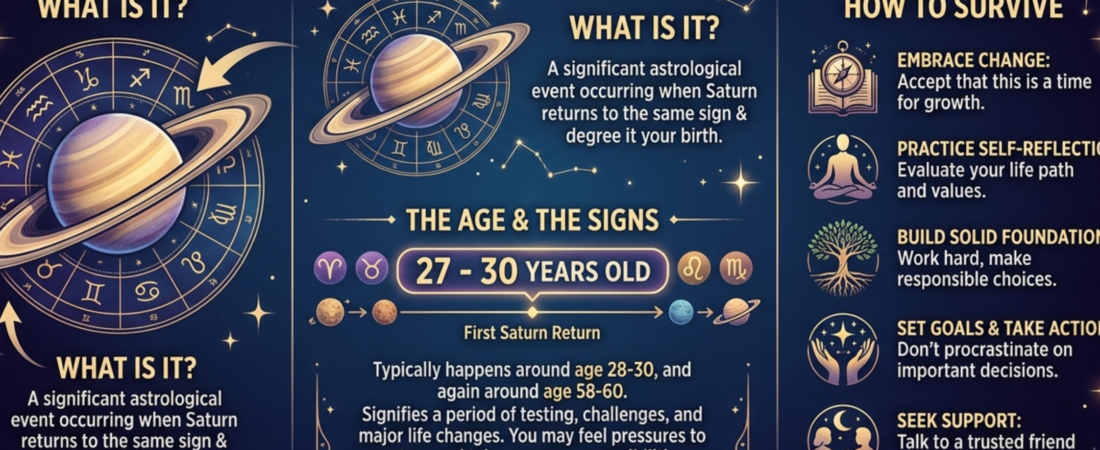
A Saturn return happens when the planet Saturn completes its roughly 29.5 year orbit and returns to the exact zodiac position it occupied at your birth. It marks a defining astrological checkpoint where anything built on avoidance rather than authenticity tends to fall away, while whatever genuinely reflects who you are becomes far more clearly yours.
Ruling Planet
Saturn
Orbit Length
About 29.5 Years
First Return
Ages 27 to 30
Occurs In A Lifetime
Up To 3 Times
Core Theme
Discipline & Reckoning
There is a reason that people who have been through a Saturn return describe it the same way, regardless of whether they know anything about astrology. They describe a period — usually lasting two to three years, usually arriving around their late twenties — in which everything that was not quite right about their life suddenly became impossible to ignore. The career that was acceptable but not genuinely fulfilling. The relationship that was comfortable but not genuinely connected. The version of themselves they had built for other people’s approval rather than their own authentic direction. Saturn does not destroy these things arbitrarily. It simply withdraws the energy that was sustaining them — the tolerance for compromise, the capacity for comfortable avoidance — and what remains, once that energy is withdrawn, is clarity about what actually needs to change.
This guide covers what Saturn return really means, when it happens by age, how long it lasts, what it feels like for each zodiac sign, what life lessons it brings, how to calculate yours and — most importantly — how to survive it without losing what is genuinely worth keeping.
 Find Your Personal Year Number — What 2026 Holds For You Find Your Life Path Number — Free Calculator
What Does Saturn Return Mean in Astrology?
In astrology, Saturn is the planet of discipline, structure, limitation, karmic accountability and the long-term consequences of choices made or avoided. Unlike Jupiter, which expands and rewards, Saturn contracts and demands. It is the taskmaster of the solar system — the planetary force that insists on genuine quality over comfortable approximation, on authentic direction over convenient drift.
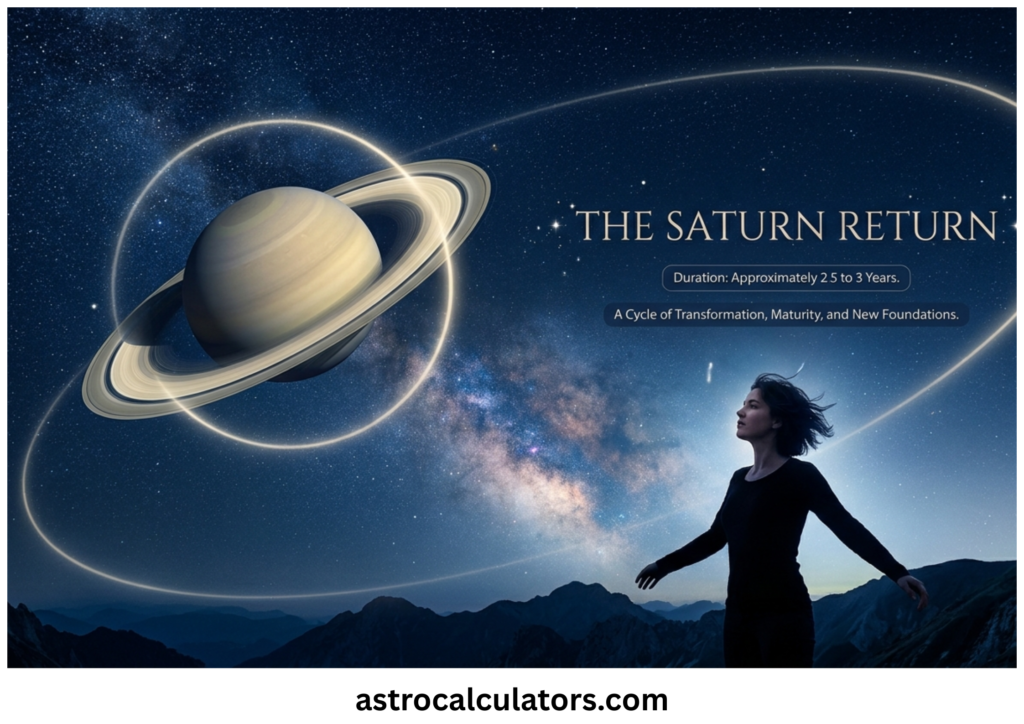
Saturn takes approximately 29.5 years to complete one full orbit of the Sun. When it returns to the exact position it occupied at the moment of your birth — the same zodiac sign, degree and house — this is your Saturn return. The return is not a single day but a transit that unfolds over two to three years, during which Saturn’s demanding energy is particularly focused on the specific areas of your life that its natal placement governs.
The astrological significance of Saturn return is difficult to overstate. In the Western astrological tradition, the Saturn return has been recognised as one of the most consistently significant life transitions in the entire planetary cycle — more reliably transformative than any other transit in terms of its capacity to produce genuine, lasting and non-optional change. The changes it produces are not always pleasant in the moment. They are, with remarkable consistency across the accounts of people who have been through them, recognised in retrospect as the most important recalibrational moments of their lives.
Saturn is often called the planet of karma — not in the superficial sense of cosmic reward and punishment, but in the more precise sense of the natural consequences of sustained patterns of choice. The Saturn return brings those consequences into visibility. What you have built consistently and authentically tends to be recognised and rewarded. What you have built inconsistently or inauthentically tends to reveal its structural weaknesses and require either genuine repair or release.
What Is Your Untamed, Shadow Self?
Find your Lilith sign, free in seconds.
When Does Saturn Return Happen — The Ages Explained?
Saturn return happens three times in a full lifetime, each occurring approximately 29.5 years apart. Understanding what each return typically brings — and how it differs from the others — is as important as knowing when it arrives.
What Is the First Saturn Return — Ages 27 to 30?
The first Saturn return is the most widely discussed and the most immediately disruptive for most people — because it arrives at the precise moment when the structures of young adulthood are being tested for the first time by genuine adult consequence. Between ages 27 and 30, Saturn returns to its natal position and begins asking a question that most people in their early to mid-twenties have been successfully avoiding: are you actually living your life, or are you living the life that other people’s expectations, your own fear or simple inertia have produced?
The first Saturn return commonly produces: career crises or complete career changes, as the direction chosen at 21 reveals itself to be someone else’s idea of a good life rather than your own; significant relationship shifts, either the deepening of genuinely right partnerships or the ending of ones that were held together by comfortable habit rather than genuine choice; a questioning of identity that can feel destabilising but is actually the most important developmental work of early adulthood — the excavation of what is genuinely true about who you are beneath the layers of performance and accommodation that most people accumulate in their twenties.
The first Saturn return is not a punishment. It is the most significant growth invitation available in young adulthood — the moment when Saturn withdraws its patience with comfortable inauthenticity and insists on genuine self-knowledge. The people who engage with it consciously — who use the disruption as information rather than resisting it as threat — consistently emerge from their Saturn return more genuinely themselves than they have ever been.
What Is the Second Saturn Return — Ages 56 to 59?
The second Saturn return arrives in the mid-to-late fifties and brings a characteristically different quality from the first. Where the first return is primarily about establishing genuine authenticity in the direction of a life that is still largely ahead, the second return is primarily about reassessment and deepening — about examining what has been built across the three decades since the first return and honestly evaluating whether it still reflects who you genuinely are.
The second Saturn return commonly produces: a deep re-evaluation of career legacy, particularly around whether the work of the previous thirty years has produced the meaning and contribution that the first Saturn return directed you toward; significant relationship reconsideration, as partnerships that have been genuinely built on authentic mutual respect are deepened, while those sustained by habit or obligation without genuine connection become harder to maintain; a confrontation with the physical dimension of Saturn’s lesson, as the body begins to register the long-term consequences of the choices made in the previous cycle regarding health, rest and self-care.
The second Saturn return has a quality that the first does not — a clarity about time. The awareness that the remaining life ahead is finite, that the decades available for significant change are fewer than those already lived, gives the second Saturn return a specific urgency. The question it asks is not who am I really — that was the first return’s question. The question it asks is: given everything I now know about who I am and what matters, how do I want to use the time that remains?
What Is the Third Saturn Return — Ages 84 to 88?
The third Saturn return, when it occurs, arrives in the late eighties and carries the quality of completion and integration. Its themes are legacy, release and the reckoning with a life lived — the Saturn accounting of what was built, what was left undone and what was genuinely offered to the world. Not all people live to experience the third Saturn return fully, which gives those who do a specific and unusual perspective on the accounting of a complete life.
How Long Does a Saturn Return Last?
A Saturn return lasts approximately two to three years — not the single astrological event that popular astrology often implies. Saturn moves through approximately one zodiac sign every two and a half years, and during the period it transits through your natal Saturn’s sign, its energy is directly engaging your natal Saturn placement. The return itself — the exact moment when transiting Saturn conjuncts your natal Saturn — occurs within this larger transit period and may happen up to three times due to Saturn’s retrograde motion.
The experience of a Saturn return is therefore not a single crisis moment but a sustained period of increased Saturnian pressure — a two-to-three-year window in which the themes relevant to your natal Saturn placement are brought into consistent focus. Understanding this timeline matters practically: if you are in a Saturn return and the first year has brought significant disruption, the disruption is not over because the calendar has changed. The full transit needs to complete before the pressure fully lifts.
The period immediately following the Saturn return — the year or so after Saturn moves on from your natal position — is often experienced as a significant lightening. People who have navigated their Saturn return consciously frequently describe the post-return period as one of the most genuinely settled and purposeful phases of their lives — because the authentic direction that the Saturn return demanded has been established, and the energy that was previously maintaining the structures that needed to change is now available for building what is genuinely right.
LP7 individuals frequently encounter their most significant partnerships — including LP2 connections — during Saturn Return. Read Life Path 2 and 7 Compatibility
How Do I Calculate My Saturn Return?
Calculating your Saturn return requires knowing three pieces of information: your natal Saturn sign (the zodiac sign Saturn occupied at the moment of your birth), your natal Saturn degree (the precise degree within that sign), and the current position of transiting Saturn.
Your natal Saturn sign and degree are found in your birth chart — the astrological map of the planetary positions at your exact time, date and location of birth. If you do not know your birth chart, a professional astrologer or birth chart calculator can produce it from your birth details.
Once you know your natal Saturn sign, your Saturn return begins when transiting Saturn enters that same sign and intensifies as it approaches your exact natal degree. It peaks at the exact conjunction between transiting and natal Saturn and begins to ease as Saturn moves beyond that degree and eventually out of the sign.
For practical timing purposes, the age ranges of 27–30, 56–59 and 84–88 provide a reliable general guide — most people experience the most intense Saturn return themes within these windows. However, the exact timing within those ranges varies by birth date, and the specific areas of life most affected depend on which house your natal Saturn occupies in your birth chart.
A dedicated Saturn Return Calculator — which takes your birth date and calculates your exact Saturn return window and the specific themes it activates — is in development for astrocalculators.com. In the meantime, the free Personal Year Number Calculator identifies your current numerological cycle year, which provides a complementary timing framework for understanding where you are in your personal development cycle alongside your Saturn return..
What Does Saturn Return Feel Like — The Signs and Symptoms?
The experience of a Saturn return has a recognisable quality that most people who have been through one describe in strikingly similar terms — regardless of whether they knew at the time what they were experiencing astrologically.
The first and most consistent signal of a Saturn return is a growing intolerance for inauthenticity — a specific restlessness with whatever aspects of life do not feel genuinely chosen. This intolerance tends to arrive gradually, building in intensity over the first months of the transit until what was previously tolerable — the job that is fine but not right, the relationship that is comfortable but not genuinely fulfilling, the city or lifestyle that made sense at 23 but feels increasingly wrong — becomes actively unsustainable. This is not irrational dissatisfaction. It is Saturn’s function operating precisely as intended: the withdrawal of tolerance for what is not genuinely yours so that you are motivated to find and build what is.
The second signal is an intensification of external pressure in the specific areas of life where your choices have been least authentic. Saturn operates through consequence — the natural results of sustained patterns of choice becoming impossible to ignore. During a Saturn return, the career built on others’ expectations rather than genuine vocation tends to produce its most visible dissatisfaction. The relationship sustained by inertia rather than genuine choice tends to produce its most visible friction. The financial patterns built on avoidance rather than conscious management tend to produce their most visible consequences. These are not punishments. They are Saturn’s insistence that what is genuinely wrong be genuinely addressed rather than indefinitely managed.
The third signal — and the one that most distinguishes a Saturn return from ordinary life difficulty — is a specific quality of inexorability. The things that need to change during a Saturn return tend to keep becoming more undeniable regardless of how hard you work to maintain them. The relationship you have been trying to improve may simply not improve despite genuine effort. The career direction you have been trying to make work may simply stop producing the results that sustained it before. This inexorability is not cruelty. It is clarity — Saturn’s insistence on honest acknowledgement of what has genuinely completed versus what needs to be genuinely built.
Understanding your Birth Number alongside your Saturn Return timing gives you a more complete picture of the specific personal patterns Saturn is asking you to evolve. Birth Number Calculator →
Know Your Sun, Moon and Rising Sign
Get your complete Big 3 reading free in seconds.
What Does Saturn Return Feel Like for Each Zodiac Sign?
The specific experience of a Saturn return is shaped by the zodiac sign that Saturn occupies in your natal chart — because each sign colours Saturn’s energy with its own specific qualities and themes.
Saturn in Aries natal — the Saturn return brings a reckoning with independence and initiative. The question is whether you have been genuinely leading your own life or following others’ directions while believing yourself to be self-directed. The return often produces a forceful break from dependencies that were limiting genuine self-determination.
Saturn in Taurus natal — the Saturn return focuses on material security and values. Financial structures that were built on unstable foundations tend to require rebuilding. The deeper question is whether the security you have been pursuing reflects your genuine values or simply the values of the environment you grew up in.
Saturn in Gemini natal — the Saturn return brings a reckoning with communication and mental focus. The tendency to stay perpetually in motion between ideas, commitments and directions is challenged. The return asks for depth over breadth — for the sustained commitment to one direction that genuine mastery requires.
Saturn in Cancer natal — the Saturn return focuses on home, family and emotional foundation. The structures of family relationship and domestic life that are not genuinely sustaining tend to require honest reassessment. The deeper question is whether you have developed sufficient emotional self-sufficiency to give generously rather than from need.
Saturn in Leo natal — the Saturn return brings a reckoning with creative expression and the relationship between approval and authentic self-expression. The question is whether you have been creating for genuine self-expression or for the validation of others. The return tends to strip away external validation and demand that creative work stand on its own genuine merit.
Saturn in Virgo natal — the Saturn return focuses on service, health and the relationship between perfectionism and genuine effectiveness. The question is whether the standards you hold yourself to are serving genuine quality or simply the anxiety of not being enough. The return asks for the specific form of self-compassion that allows genuine service without chronic self-criticism.
Saturn in Libra natal — the Saturn return brings a reckoning with partnership and the relationship between authentic fairness and people-pleasing. Relationships that have been maintained through the management of harmony rather than genuine mutual respect tend to require honest reassessment. The return asks for the capacity to choose authentically rather than diplomatically.
Saturn in Scorpio natal — the Saturn return focuses on power, depth and transformation. The question is whether control is being used to protect genuine vulnerability or to prevent the genuine intimacy that vulnerability makes possible. The return tends to produce the most significant personal transformation of the natal chart placements — forcing the full depth of Scorpionic change.
Saturn in Sagittarius natal — the Saturn return brings a reckoning with belief, meaning and the relationship between freedom and genuine commitment. The question is whether philosophical freedom has produced genuine wisdom or simply the avoidance of commitment. The return asks for the specific courage to commit to a direction and sustain it through the years required to produce genuine understanding.
Saturn in Capricorn natal — the Saturn return is particularly intense, because Saturn is in its home sign and its energy is undiluted. The reckoning is with ambition, authority and the relationship between external achievement and genuine purpose. The question is whether the structures built so carefully have been built for yourself or for the approval of the external world.
Saturn in Aquarius natal — the Saturn return focuses on community, innovation and the relationship between individuality and genuine contribution. The question is whether the rejection of conventional structures has produced genuine freedom or simply a different form of limitation. The return asks for the specific maturity to contribute to collective structures without losing individual authenticity.
Saturn in Pisces natal — the Saturn return brings a reckoning with spiritual reality and the relationship between idealism and genuine embodied presence. The question is whether spiritual orientation has produced genuine compassion or a form of avoidance. The return asks for the specific grounding that brings spiritual depth into practical service.
What Are the Saturn Return Life Lessons?
The life lessons of a Saturn return are consistently the same across all signs, all birth charts and all people who have navigated one — because they reflect the unchanging nature of Saturn’s astrological function rather than the specific circumstances of any individual life.
The first life lesson is the distinction between what is genuinely yours and what you have accumulated through compliance, fear or the path of least resistance. Saturn return does not take what is genuinely yours. It removes what was never really yours to begin with — the direction chosen for approval, the relationship maintained for comfort, the identity constructed for belonging rather than authenticity. The lesson is that what remains after the removal is the most genuinely valuable thing you have — because it has passed Saturn’s test of authenticity.
The second life lesson is that discipline in the service of genuine purpose is not limitation but liberation. Saturn’s energy is often experienced as constricting — as the removal of options, the imposition of consequences, the demand for accountability. The lesson of the Saturn return is that this constriction is not restriction but focus — the specific form of limitation that makes deep excellence possible by preventing the dispersion of energy across too many directions simultaneously.
The third life lesson is that genuine maturity is not the absence of vulnerability but the willingness to be responsible for one’s own experience rather than attributing it to circumstance or other people. The Saturn return confronts most people with a version of their life that has been shaped more by default than by conscious choice — by what happened to them rather than what they deliberately built. The lesson is that genuine adulthood begins with the full acceptance of authorship over one’s own life.
The fourth life lesson is patience — the specific Saturn quality of trusting that consistent, disciplined effort in a genuinely right direction produces results that are proportional to the quality of the effort, on Saturn’s timeline rather than the ego’s.
The fifth life lesson — and the one that most people come to appreciate most deeply in retrospect — is that loss is often the precondition of genuine gain. The job that ended during a Saturn return made room for the genuinely right career. The relationship that ended made room for the genuinely right partnership. The identity that dissolved made room for the genuinely authentic self. Saturn removes what is not genuinely yours not as punishment but as preparation.
For what each zodiac sign specifically needs to release in order to move forward — and the precise approach that works for each sign — read What Each Zodiac Sign Needs to Let Go Of.
Are Your Life Path Numbers a Love Match?
Check your numerology love compatibility free in seconds.
How Does Your Moon Sign Shape the Way You Experience Your Saturn Return?
Your Saturn return is defined by where Saturn was at your birth, not by your Moon — but your Moon sign still plays a real role in how the transit actually feels while you’re living through it. Saturn’s return brings restructuring and hard-won clarity for everyone, but your Moon sign governs the emotional lens that restructuring gets processed through — whether you tend to internalize the pressure quietly, express it outwardly, seek comfort in close relationships, or retreat into independence while you work through it.
Someone with a Cancer or Pisces Moon, for instance, is likely to feel the emotional weight of a Saturn return more intensely and process it through close relationships and home life, while someone with an Aquarius or Gemini Moon may process the same transit more intellectually, through changing ideas and social circles rather than deep emotional introspection. Neither response is right or wrong — they’re simply different emotional operating systems moving through the same astrological event.
Use the free Moon Sign Calculator below to find your Moon sign and better understand your own emotional pattern through significant life transits like this one.
How to Survive Your Saturn Return?
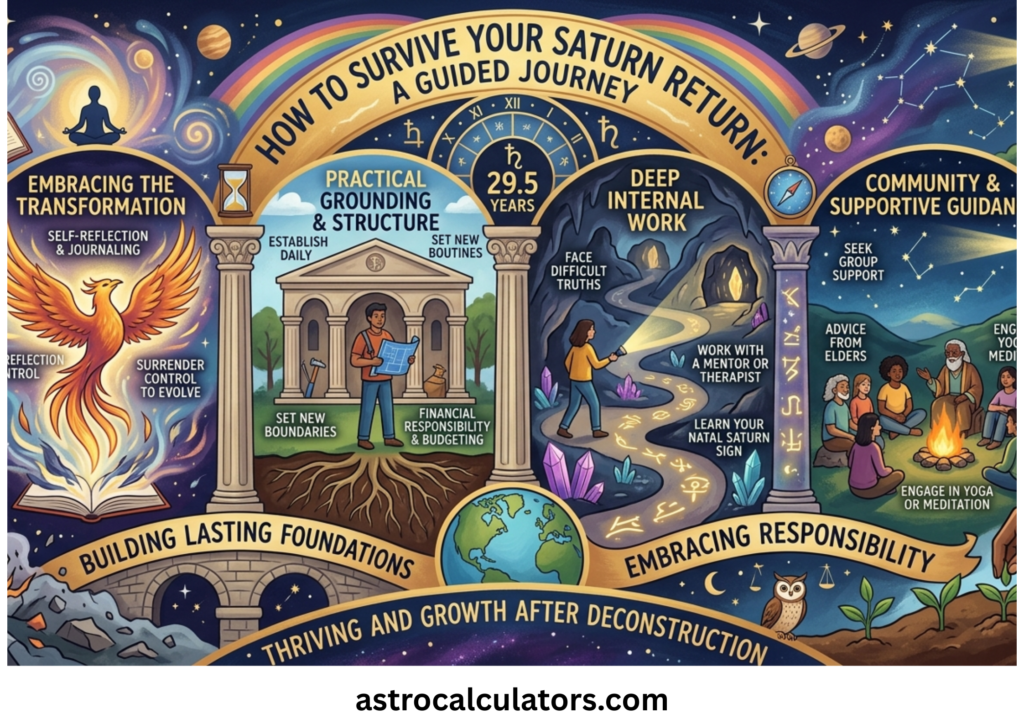
Surviving a Saturn return is less about resisting what it brings and more about engaging with it consciously enough that you emerge from it with what is genuinely yours rather than what the return took with it.
The first principle of navigating a Saturn return is to resist the impulse to immediately rebuild what is falling apart. Saturn return dismantles before it clarifies, and the impulse to rush back into a new relationship, a new career or a new identity immediately after the old one has collapsed is almost always an attempt to avoid the discomfort of the clarity phase rather than a genuine move toward something right. The clarity phase — the period of uncertainty and rebuilding that follows the dismantling — is Saturn’s most important gift. It is the space in which genuine self-knowledge becomes possible.
The second principle is to take the Saturn return’s disruptions as information rather than as random misfortune. Every area of life that becomes unsustainable during a Saturn return is telling you something specific about where your choices have been least authentic. The career crisis is not bad luck — it is Saturn pointing directly at the place where your professional direction has diverged from your genuine vocation. The relationship difficulty is not your partner’s fault — it is Saturn pointing at the specific dynamic that has been preventing genuine intimacy. Using the disruption as information rather than resisting it as threat produces dramatically different outcomes.
The third principle is to engage with whatever structure, discipline and accountability the return is demanding rather than trying to maintain the comfort of the previous period. Saturn rewards effort that is consistent, disciplined and directed toward something genuinely worth building. The Saturn return period is one of the highest-return investment periods of any life — the work done during a Saturn return, when done in genuinely the right direction, compounds in ways that equivalent effort at other points in the cycle does not.
The fourth principle is to find the support structures that Saturn’s energy is asking you to build. A Saturn return is not a period for solitary heroism. It is a period for honest engagement with the people, practices and structures that can provide the genuine ground that authentic rebuilding requires. Therapy, coaching, genuine mentorship, honest community — these are not signs of weakness during a Saturn return. They are the specific forms of Saturnian structure that the period is asking you to develop.
The fifth principle is to remember that Saturn return ends. The pressure that characterises the two-to-three year transit is temporary — and what you build during it, if built genuinely and with the discipline Saturn rewards, is among the most durable and authentically yours of anything you will construct in your life.
Your Saturn return timing aligns with your personal numerological cycle. Your Personal Year Number identifies where you are in your 9-year cycle — and whether 2026 is a year of building, releasing or beginning for you specifically.
Frequently Asked Questions — Saturn Return Meaning
What does Saturn return mean in astrology?
Saturn return in astrology refers to the transit that occurs when the planet Saturn completes its approximately 29.5-year orbit and returns to the exact zodiac sign and degree it occupied at the moment of your birth. It is one of the most consistently significant astrological transits in a person’s lifetime — a period in which Saturn’s energy as the planet of discipline, structure and karmic accountability focuses specifically on the areas of life where your choices have been least authentic, your structures least genuinely solid and your direction least genuinely your own. The Saturn return is not an external event that happens to you. It is an internal reckoning that becomes impossible to avoid.
How old is the second Saturn return?
The second Saturn return occurs around ages 56 to 59 — approximately 29.5 years after the first return at ages 27–30. The exact timing within this range depends on your natal Saturn placement and the specific degree Saturn occupied at your birth. The second Saturn return differs from the first in both its tone and its focus: where the first return is primarily about establishing genuine authenticity in a life that is largely ahead, the second return is primarily about honest reassessment of what has been built in the decades since and a clear-eyed evaluation of how to use the years remaining most genuinely and purposefully.
How do I calculate my Saturn return?
Your Saturn return is calculated from your natal Saturn placement — the zodiac sign and exact degree that Saturn occupied at the moment of your birth. Your Saturn return begins when transiting Saturn enters that same zodiac sign and intensifies as it approaches your exact natal degree. The general age ranges of 27–30 for the first return, 56–59 for the second and 84–88 for the third provide reliable estimates — but the exact timing within those ranges depends on your specific birth date and the degree of Saturn in your natal chart. A dedicated Saturn Return Calculator for astrocalculators.com is planned for release — when published it will calculate your exact Saturn return window from your birth date. In the meantime, the free Personal Year Number Calculator provides a complementary numerological timing framework.
How long does a Saturn return last?
A Saturn return lasts approximately two to three years — not a single event or moment. Saturn transits through each zodiac sign over approximately two and a half years, and during the period it moves through your natal Saturn’s sign, its energy is directly engaging your natal placement. The exact conjunction between transiting and natal Saturn — the moment of the return itself — may occur up to three times due to Saturn’s retrograde motion, each pass intensifying the themes the transit is activating. The full pressure of the Saturn return eases as Saturn moves beyond your natal degree and eventually exits the sign, at which point most people experience a significant and often profound sense of clarity and settledness.
What is the Saturn return in 7 years?
The “Saturn return 7 years” search reflects the commonly misunderstood relationship between Saturn’s approximately 7-year quarterly cycle and the full Saturn return. Saturn takes 29.5 years to complete a full orbit — but at approximately every 7 years, Saturn forms a significant angular relationship with its natal position (a square at 7 years, an opposition at 14–15 years, another square at 21–22 years and the full return at 29.5 years). These 7-year Saturn milestones are mini-Saturn returns — periods of recalibration and increased Saturnian pressure that are smaller in scale than the full return but follow the same basic pattern of confronting what is not genuinely working and demanding honest reassessment. The age-7 recalibration, the age-14 opposition and the age-21 pre-return square are all recognisable in retrospect as moments when the themes that culminate in the full Saturn return at 27–30 were first introduced.
Does my zodiac sign affect my Saturn return?
Not in terms of timing — the exact date of your Saturn return is determined by where Saturn itself was positioned at your birth, not by your Sun sign. Two people with the same zodiac sign but different birth years can have Saturn in entirely different signs and experience their returns at different points in their late twenties. However, your zodiac sign does meaningfully shape how you experience the Saturn return emotionally and psychologically, since the transit tends to interact with the core traits and challenges already associated with your sign — which is why the specific flavor of the transit can look genuinely different for an Aries than for a Cancer, even when the underlying astrological mechanics are the same for everyone.
What are the signs you’re going through a Saturn return?
Common signs of a Saturn return include a persistent sense that current circumstances — a job, a relationship, a living situation — no longer fit who you’re becoming, along with a genuine pull toward more responsibility, structure and long-term commitment than felt necessary before. Many people report significant life changes during this period, including career shifts, the end or deepening of long-term relationships, relocation, or a broader reassessment of personal values and direction. The transit is frequently described as challenging in the moment but genuinely clarifying in retrospect.
How can I prepare for my Saturn return?
The most useful preparation for a Saturn return is honest self-reflection about which parts of your current life genuinely reflect your own values and choices, and which parts you’ve simply drifted into without much conscious decision. Since Saturn’s influence tends to reward authenticity and sustained effort over shortcuts or avoidance, using this period to build real structure around your genuine priorities — rather than resisting the discomfort of change — tends to produce the most positive long-term outcome. Knowing your exact Saturn return dates in advance can also help you approach the period with intention rather than being caught off guard by it.
Use the free Saturn Return Calculator to find your exact Saturn return dates based on your birth information.
Discover your full zodiac sign guide
Explore insights for all 12 zodiac signs and what the stars reveal about you.
View All Signs