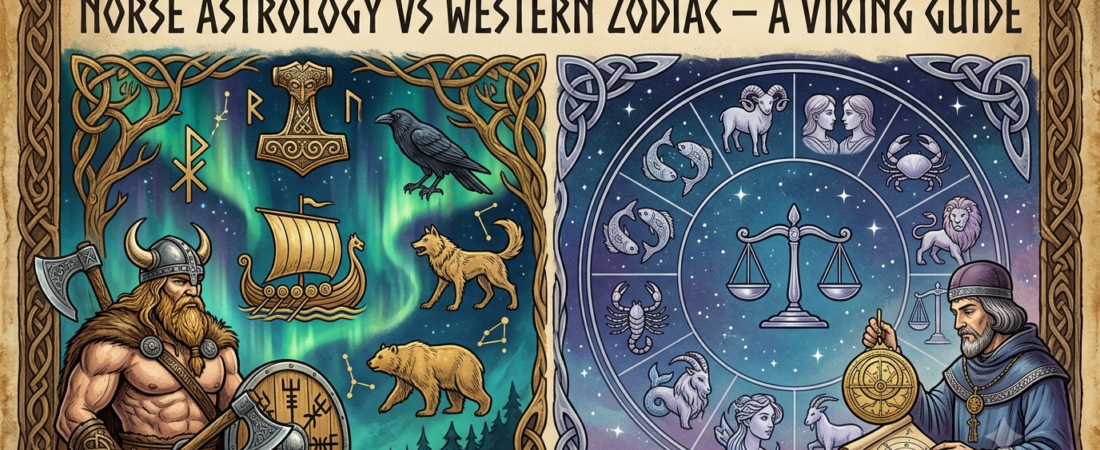
Norse astrology uses 24 Elder Futhark runes assigned by birth date rather than 12 zodiac signs, and is governed by Norse gods (Odin, Thor, Freya) rather than planets. Where Western astrology describes your personality through celestial positions at birth, Norse astrology reveals your life path through the rune energy you were born under and the Viking god who governs your destiny. Both systems can be used together for a more complete picture.
Norse System
24 Elder Futhark Runes
Western System
12 Zodiac Signs + Planets
Based On
Birth Date (both systems)
Norse Governed By
Odin, Thor, Freya & the Norns
Celtic System
13 Tree Signs by Birth Month
Guardian Angels
Guide Your Runic Path
What Is Norse Astrology and How Is It Different From Western Astrology?
Norse astrology is the ancient Scandinavian system for understanding personality, fate and life purpose — rooted in Viking mythology, the Elder Futhark runic alphabet and the cosmological worldview of the Norse people who developed it over more than a thousand years before the Christian era transformed the cultural landscape of Northern Europe. Where Western astrology is a Greco-Roman system built on the observation of planetary positions against the backdrop of twelve zodiac constellations, Norse astrology is a mythological and runic system built on the 24 symbols of the Elder Futhark — the oldest form of the runic alphabet — each of which corresponds to a period of the year, a Norse deity, a specific natural force and a set of personality and life path characteristics that the Vikings believed were encoded in a person’s birth date.
The most fundamental difference between the two systems is the cosmological framework underlying them. Western astrology locates meaning in the movements of celestial bodies — the position of the Sun, Moon and planets at the moment of birth, interpreted through the symbolic language of twelve zodiac signs and twelve astrological houses. Norse astrology locates meaning in the interplay of mythological forces — the governing influence of Odin (wisdom and fate), Thor (strength and protection), Freya (love and fertility), Tyr (justice), Loki (transformation) and the other Norse gods whose qualities colour the rune periods they govern. In the Norse worldview, your birth date does not reveal which constellation the Sun was passing through — it reveals which runic force and which divine energy was most present at the moment you arrived, and therefore which mythological pattern your life is most likely to follow.
Both systems use your birth date as the primary input, and both produce a description of personality, natural strengths, shadow tendencies and life direction. The experience of reading them, however, is distinctly different. A Western astrology reading feels cosmological — rooted in the geometry of the solar system and the precise mathematical relationships between planetary positions. A Norse astrology reading feels mythological — rooted in stories, symbols, divine archetypes and the specific quality of wisdom that the Vikings encoded in their runes over centuries of use. Many practitioners of both systems find that they illuminate different and complementary dimensions of the same person.
What Are the 24 Norse Birth Runes? — Complete Reference Chart
The Elder Futhark is divided into three groups of eight runes called Aettir — Freya’s Eight, Hagal’s Eight and Tyr’s Eight — each governed by a different Norse deity and carrying a different overall thematic energy. Your birth rune is determined by the period of the year in which you were born. The table below gives the complete birth rune calendar.
| Birth Dates | Rune | Norse God | Core Meaning | Western Equivalent |
|---|---|---|---|---|
| 29 Jun – 14 Jul | ᚠ Fehu | Freya | Abundance, wealth, new beginnings | Cancer / Leo cusp |
| 14 Jul – 29 Jul | ᚢ Uruz | Thor | Primal strength, endurance, wildness | Leo |
| 29 Jul – 13 Aug | ᚦ Thurisaz | Thor | Protection, reactive force, boundaries | Leo / Virgo cusp |
| 13 Aug – 29 Aug | ᚨ Ansuz | Odin | Wisdom, communication, divine inspiration | Virgo |
| 29 Aug – 13 Sep | ᚱ Raidho | Ing / Freyr | Journey, movement, right action | Virgo / Libra cusp |
| 13 Sep – 28 Sep | ᚲ Kenaz | Freya | Torch, creativity, knowledge, craft | Libra |
| 28 Sep – 13 Oct | ᚷ Gebo | Odin / Freya | Gift, partnership, sacred exchange | Libra / Scorpio cusp |
| 13 Oct – 28 Oct | ᚹ Wunjo | Odin | Joy, harmony, belonging, fulfilment | Scorpio |
| 28 Oct – 13 Nov | ᚺ Hagalaz | Urd (the Norn) | Hail, disruption, transformation through chaos | Scorpio / Sagittarius cusp |
| 13 Nov – 28 Nov | ᚾ Nauthiz | Skuld (the Norn) | Need, constraint, necessity, inner fire | Sagittarius |
| 28 Nov – 13 Dec | ᛁ Isa | Verdandi (the Norn) | Ice, stillness, self-reflection, patience | Sagittarius / Capricorn cusp |
| 13 Dec – 28 Dec | ᛃ Jera | Freyr | Year, harvest, cycles, earned reward | Capricorn |
| 28 Dec – 13 Jan | ᛇ Eihwaz | Odin / Ullr | Yew tree, endurance, death & rebirth | Capricorn / Aquarius cusp |
| 13 Jan – 28 Jan | ᛈ Perthro | Frigg | Fate, mystery, hidden knowledge, chance | Aquarius |
| 28 Jan – 13 Feb | ᛉ Algiz | Heimdall | Protection, guardian, connection to divine | Aquarius / Pisces cusp |
| 13 Feb – 27 Feb | ᛊ Sowilo | Sol (sun goddess) | Sun, victory, wholeness, divine will | Pisces |
| 27 Feb – 14 Mar | ᛏ Tiwaz | Tyr | Justice, sacrifice, honour, warrior spirit | Pisces / Aries cusp |
| 14 Mar – 30 Mar | ᛒ Berkano | Frigg / Freya | Birch, growth, fertility, new beginnings | Aries |
| 30 Mar – 14 Apr | ᛖ Ehwaz | Odin / Freya | Horse, partnership, trust, movement | Aries / Taurus cusp |
| 14 Apr – 29 Apr | ᛗ Mannaz | Odin / Frigg | Humanity, self, divine potential | Taurus |
| 29 Apr – 14 May | ᛚ Laguz | Njord | Water, flow, intuition, the unconscious | Taurus / Gemini cusp |
| 14 May – 29 May | ᛜ Ingwaz | Freyr / Ing | Fertility, inner growth, completion | Gemini |
| 29 May – 14 Jun | ᛞ Dagaz | Odin / Heimdall | Dawn, breakthrough, transformation, clarity | Gemini / Cancer cusp |
| 14 Jun – 29 Jun | ᛟ Othala | Odin | Heritage, home, ancestral wisdom, belonging | Cancer |
Each rune period is approximately 15 days long — slightly shorter than a Western zodiac sign period of approximately 30 days. This means your Norse birth rune describes a more specific window of your birth year than your Western zodiac sign, producing a reading that many people find more personally precise. To find your Western zodiac sign for comparison, use the Zodiac Sign Finder.
Who Were the Norse Gods That Govern the Runes?
In Norse astrology, the gods who govern the rune periods are not abstract planetary forces — they are fully developed mythological personalities with specific stories, qualities, powers and domains that colour the rune periods they govern. Understanding which Norse god rules your birth rune gives you a richer and more mythologically grounded picture of the energy you were born under.
Odin — the Allfather, god of wisdom, war, death, poetry and magic — governs more rune periods than any other deity, including Ansuz, Wunjo, Eihwaz, Ehwaz, Mannaz, Dagaz and Othala. If Odin governs your birth rune, you carry his qualities of relentless curiosity, willingness to sacrifice for wisdom and the specific gift of being able to see patterns that others miss. Odin hung upside down from Yggdrasil, the World Tree, for nine days and nights to receive the gift of the runes — making every rune he governs a symbol of knowledge earned through genuine trial.
Thor — the god of thunder, strength and the protection of Midgard (the human world) — governs Uruz and Thurisaz. If Thor governs your birth rune, you carry his qualities of raw physical and emotional strength, his fierce protectiveness of the people he loves and his directness of action that cuts through complexity to the essential. Thor is not subtle — but he is dependable in a way that most other gods are not, and his rune people share this quality of being someone others instinctively feel safer around.
Freya — goddess of love, fertility, war and magic — governs Fehu and Kenaz, and co-governs Gebo and Ehwaz. If Freya governs your birth rune, you carry her qualities of magnetic sensual attractiveness, fierce independence, genuine emotional depth and the specific gift of the seidr — the Norse tradition of magic and prophetic sight that Freya taught to Odin himself. Freya people are often extraordinarily capable in both the material and spiritual dimensions of life simultaneously.
The Norns — Urd (what was), Verdandi (what is) and Skuld (what shall be) — are the three weavers of fate who govern the middle rune period including Hagalaz, Nauthiz and Isa. If a Norn governs your birth rune, you carry a particular relationship with fate, necessity and the specific kind of wisdom that can only develop through genuine difficulty. Norn rune people frequently experience significant disruption in early life that becomes the foundation of their deepest understanding.
Tyr — the one-handed god of justice, law and honourable sacrifice — governs Tiwaz. Tyr people carry his qualities of moral clarity, willingness to sacrifice personal interest for the greater good and the specific kind of courage that comes not from the absence of fear but from the presence of principle. Freyr — twin brother of Freya, god of fertility, sunshine and abundance — governs Raidho, Jera and Ingwaz. Freyr people carry his qualities of natural generosity, ease with the rhythms of life and the specific gift of making things grow
How Does Norse Astrology Compare to Western Astrology Sign by Sign?
Because the Norse rune calendar runs on 15-day periods and the Western zodiac runs on 30-day periods, each Western zodiac sign overlaps with approximately two Norse birth runes. The comparison below shows which rune energies most closely parallel each Western zodiac sign — and where the Norse system adds dimensions the Western system does not address.
Aries (Mar 21 – Apr 19) corresponds to Berkano and Ehwaz. Where Western astrology describes Aries through Mars’s initiative and independent drive, Norse astrology adds Frigg and Freya’s dimension of growth and regeneration (Berkano) and Odin’s dimension of trust and partnership in forward movement (Ehwaz). The Norse reading of this period is less about individual conquest and more about new growth and trusted collaboration. Find your full Aries profile at the Aries Zodiac Sign page.
Taurus (Apr 20 – May 20) corresponds to Mannaz and Laguz. Where Western astrology describes Taurus through Venus’s sensory pleasure and material stability, Norse astrology adds Odin’s dimension of human self-knowledge and divine potential (Mannaz) and Njord’s dimension of water, intuition and the depths of the unconscious (Laguz). The Norse reading of this period is richer in its psychological and spiritual dimensions than the Western reading alone. Find your full Taurus profile at the Taurus Zodiac Sign page.
Gemini (May 21 – Jun 20) corresponds to Ingwaz and Dagaz. Where Western astrology describes Gemini through Mercury’s communicative duality and intellectual variety, Norse astrology adds Freyr’s dimension of inner completion and fertile potential (Ingwaz) and Odin/Heimdall’s dimension of breakthrough, clarity and the dawn of new understanding (Dagaz). The Norse reading gives Gemini’s characteristic mental energy a more purposeful, breakthrough-oriented quality. Find your full Gemini profile at the Gemini Zodiac Sign page.
Cancer (Jun 21 – Jul 22) corresponds to Othala and Fehu. Where Western astrology describes Cancer through the Moon’s emotional nurturance and home-orientation, Norse astrology adds Odin’s dimension of ancestral heritage, belonging and the wisdom of lineage (Othala) and Freya’s dimension of abundance and new material beginnings (Fehu). The Norse reading grounds Cancer’s emotional world in a specifically ancestral and familial context. Find your full Cancer profile at the Cancer Zodiac Sign page.
Leo (Jul 23 – Aug 22) corresponds to Uruz and Thurisaz. Where Western astrology describes Leo through the Sun’s warmth, confidence and creative expression, Norse astrology adds Thor’s dimension of primal strength and endurance (Uruz) and Thor’s protective reactive force (Thurisaz). The Norse reading of Leo is less about performance and more about raw vital strength and fierce protective energy. Find your full Leo profile at the Leo Zodiac Sign page.
Virgo (Aug 23 – Sep 22) corresponds to Ansuz and Raidho. Where Western astrology describes Virgo through Mercury’s analytical precision and service orientation, Norse astrology adds Odin’s dimension of divine wisdom and inspired communication (Ansuz) and Freyr’s dimension of purposeful movement and right action (Raidho). The Norse reading elevates Virgo’s analytical intelligence into a more explicitly wisdom-oriented and spiritually grounded quality. Find your full Virgo profile at the Virgo Zodiac Sign page.
Libra (Sep 23 – Oct 22) corresponds to Kenaz and Gebo. Where Western astrology describes Libra through Venus’s harmony, beauty and relational balance, Norse astrology adds Freya’s dimension of creative craft and illuminating knowledge (Kenaz) and Odin/Freya’s dimension of sacred gift exchange and genuine partnership (Gebo). The Norse reading gives Libra’s relational orientation a more explicitly creative and spiritually reciprocal quality. Find your full Libra profile at the Libra Zodiac Sign page.
Scorpio (Oct 23 – Nov 21) corresponds to Wunjo and Hagalaz. Where Western astrology describes Scorpio through Pluto’s transformative depth and Mars’s intensity, Norse astrology adds Odin’s dimension of joy, harmony and genuine belonging (Wunjo) and the Norn Urd’s dimension of disruptive transformation through necessary chaos (Hagalaz). The Norse reading of Scorpio is unusually balanced — both the capacity for deep joy and the experience of fate-driven disruption. Find your full Scorpio profile at the Scorpio Zodiac Sign page.
Sagittarius (Nov 22 – Dec 21) corresponds to Nauthiz and Isa. Where Western astrology describes Sagittarius through Jupiter’s expansive optimism and philosophical freedom, Norse astrology adds Skuld’s dimension of necessity, constraint and the inner fire that burns brightest when external circumstances are most difficult (Nauthiz) and Verdandi’s dimension of stillness, patience and self-reflection (Isa). The Norse reading of Sagittarius is considerably more inward and disciplined than the Western reading suggests. Find your full Sagittarius profile at the Sagittarius Zodiac Sign page.
Capricorn (Dec 22 – Jan 19) corresponds to Jera and Eihwaz. Where Western astrology describes Capricorn through Saturn’s discipline, ambition and earned authority, Norse astrology adds Freyr’s dimension of the seasonal harvest — reward that arrives in its own time after patient cultivation (Jera) and Odin/Ullr’s dimension of endurance through death and rebirth cycles (Eihwaz). The Norse reading of Capricorn adds a more explicitly cyclical and mortality-aware quality to Saturn’s themes. Find your full Capricorn profile at the Capricorn Zodiac Sign page.
Aquarius (Jan 20 – Feb 18) corresponds to Perthro and Algiz. Where Western astrology describes Aquarius through Uranus’s radical innovation and Saturn’s structural intelligence, Norse astrology adds Frigg’s dimension of fate, hidden knowledge and the mystery of what is not yet revealed (Perthro) and Heimdall’s dimension of divine protection and the bridge between human and divine realms (Algiz). The Norse reading of Aquarius is more mystical and fate-aware than the Western reading. Find your full Aquarius profile at the Aquarius Zodiac Sign page.
Pisces (Feb 19 – Mar 20) corresponds to Sowilo and Tiwaz. Where Western astrology describes Pisces through Neptune’s spiritual sensitivity and Jupiter’s compassionate expansiveness, Norse astrology adds Sol’s dimension of solar victory, wholeness and divine will breaking through (Sowilo) and Tyr’s dimension of justice, honourable sacrifice and warrior spirit (Tiwaz). The Norse reading of Pisces is considerably more martial and victory-oriented than the Western reading, adding a quality of earned spiritual triumph. Find your full Pisces profile at the Pisces Zodiac Sign page.
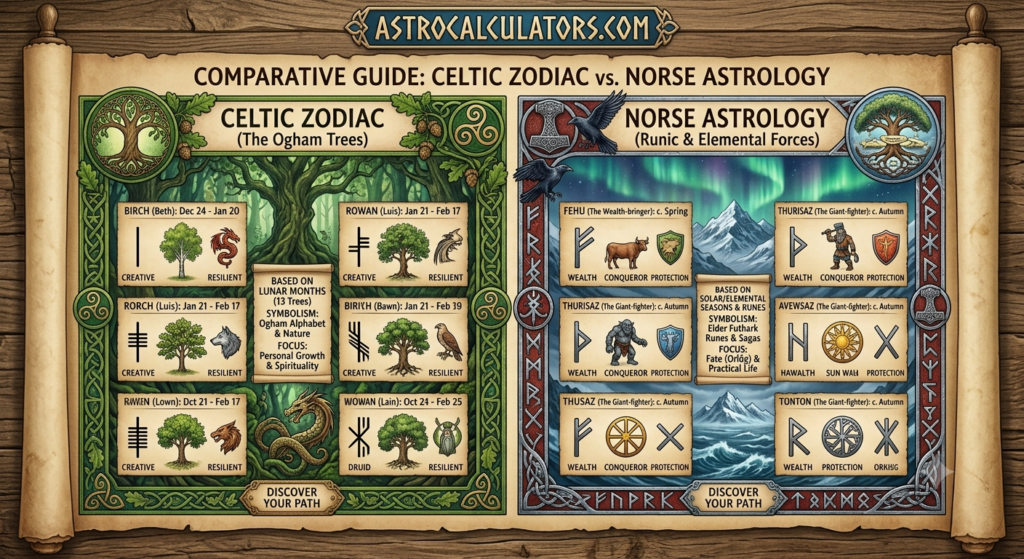
How Does the Celtic Zodiac Compare to Norse Astrology?
Norse and Celtic astrology are both Northern European indigenous systems that developed independently of the Greek and Roman astrological traditions, and both use birth-date-based symbol systems that feel distinctly different from the Western zodiac. Where Norse astrology uses 24 runes governed by Norse gods, Celtic astrology uses 13 tree signs based on the ancient Druid Ogham calendar — each sign named for a sacred tree with its own personality, elemental quality and Druidic significance. Both systems are approximately 15 days per period rather than 30 days per zodiac sign, making them more specific than Western astrology in their time windows. Use the Celtic Zodiac Sign Calculator to find your Celtic tree sign alongside your Norse birth rune.
Should You Use Norse Astrology or Western Astrology?
The most useful answer to this question is not one or the other but both — used as complementary lenses on the same person rather than competing systems that must contradict each other. Western astrology gives you the most detailed and mathematically precise picture of your birth chart, particularly when you have access to your exact birth time for a full rising sign calculation. It describes the specific quality of your mind, your emotional world, your relationship patterns and your life direction through a system that has been developed and refined over thousands of years. Norse astrology gives you a mythologically rich and symbolically deep picture of the archetypal energy you were born under — one that feels more immediately resonant for many people precisely because it operates through story and divine personality rather than mathematical precision.
Practitioners who use both systems typically find that they illuminate different dimensions of the same person — Western astrology describing the psychological and interpersonal layer with great precision, Norse astrology describing the mythological and soul-purpose layer with a quality of narrative depth that mathematical systems struggle to replicate. If you are drawn to exploring both, start with your Western birth chart using the Zodiac Sign Finder and your Big Three using the Big Three Calculator, then find your Norse birth rune in the table above and read the description of its governing deity alongside your Western chart.
Matariki 2026 · Explore More
Go Deeper Into Matariki 2026
Matariki 2026 falls on Friday 10 July. Discover what the nine stars mean, what your Life Path Number reveals for the year ahead, and which Celtic tree sign you carry — both traditions read the sky the same way.
Frequently Asked Questions — Norse Astrology vs Western Zodiac
What is my Norse zodiac sign?
In Norse astrology, you do not have a zodiac sign — you have a birth rune. Your birth rune is the Elder Futhark rune that corresponds to the 15-day period in which you were born. Find your birth rune in the complete table above by locating your birth date. Unlike Western zodiac signs which run in 30-day periods, Norse birth runes change every 15 days, making them more specific to your birth period. Each rune also has a governing Norse god whose mythological qualities colour the energy of the people born under it.
What are Norse gods’ zodiac signs?
Norse gods do not have zodiac signs in the Western astrological sense — they govern rune periods rather than planetary signs. Odin governs the most rune periods including Ansuz (Aug 13–29), Wunjo (Oct 13–28), Eihwaz (Dec 28 – Jan 13), Ehwaz (Mar 30 – Apr 14), Mannaz (Apr 14–29), Dagaz (May 29 – Jun 14) and Othala (Jun 14–29). Thor governs Uruz and Thurisaz (Jul 14 – Aug 13). Freya governs Fehu and Kenaz. The Norns govern Hagalaz, Nauthiz and Isa. Tyr governs Tiwaz. The full Norse god to rune mapping is given in the reference table above.
Is Viking astrology the same as Norse astrology?
Viking astrology and Norse astrology refer to the same system — the runic birth sign tradition rooted in Elder Futhark symbolism and Norse mythology that was used across Scandinavia during the Viking Age (approximately 793–1066 CE) and the centuries before it. The Vikings used runes for divination, magic, communication and the marking of significant objects and events, and the system of assigning birth runes based on the time of year was part of this broader runic practice. The term “Viking astrology” is the more popular modern usage; “Norse astrology” is the more academically accurate one.
How accurate is Norse astrology compared to Western astrology?
Accuracy in any astrological system is a matter of resonance rather than scientific verification — neither Norse nor Western astrology can be validated through controlled empirical study, and both operate as symbolic frameworks for self-understanding rather than predictive sciences. In terms of psychological resonance, many people find Norse astrology descriptions remarkably accurate for the same reason they find Western astrology accurate — because the archetypal categories in both systems are broad enough to describe genuine human patterns while specific enough to feel personally meaningful. The 15-day specificity of Norse birth runes often produces descriptions that feel more precisely calibrated to the individual than the broader 30-day Western zodiac signs.
What is the difference between Norse astrology and Celtic astrology?
Norse astrology uses 24 Elder Futhark runes governed by Norse gods (Odin, Thor, Freya, Tyr and others) and is rooted in Scandinavian/Germanic mythology. Celtic astrology uses 13 tree signs based on the ancient Druid Ogham alphabet and is rooted in Irish, Scottish and Welsh mythology. Both systems use approximately 15-day birth periods rather than 30-day zodiac signs, making them more specific than Western astrology. The Norse system has a more martial, fate-oriented quality reflecting Viking culture; the Celtic system has a more nature-oriented, seasonal quality reflecting Druidic culture. Use the Celtic Zodiac Sign Calculator to find your Celtic tree sign.
Recent Posts
- Venus in Libra: Love, Traits, Compatibility and Style
- Venus in Sagittarius: Love, Traits, Compatibility and Style
- Venus in Capricorn: Love, Traits, Compatibility and Style
- Venus in Scorpio: Love, Traits, Compatibility and Style
- What Your Moon Sign Reveals About Emotional Needs, Comfort, and Instincts