Quick Answer
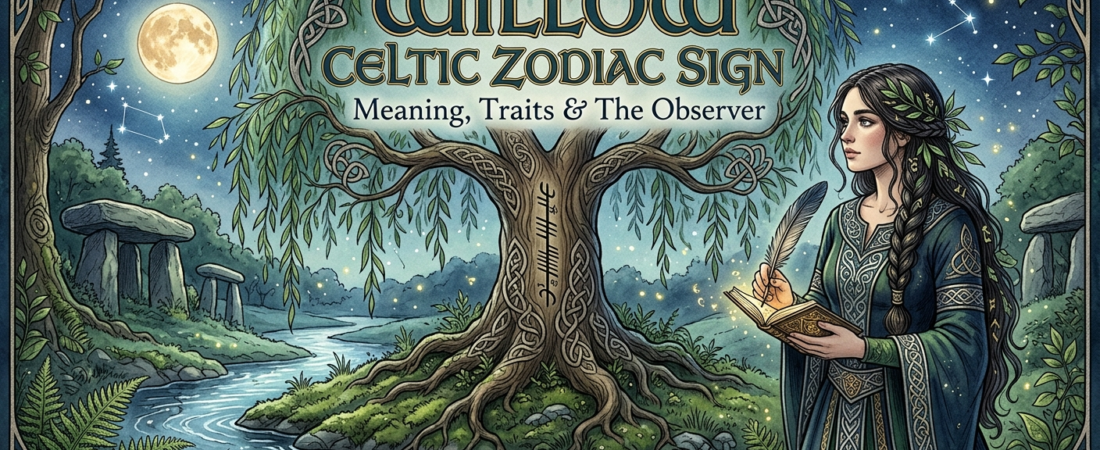
The Willow is the fifth sign of the Celtic lunar calendar, covering those born between 15 April and 12 May. Governed by the Moon — the most cyclically attuned, intuitive, and emotionally intelligent governing body in the entire Celtic astrological tradition — Willow is the sign of the deep Observer: someone who perceives the emotional and invisible dimensions of experience with extraordinary sensitivity, whose creativity flows directly from that depth of inner life, and whose capacity to change, adapt, and return — like the Willow tree itself — makes them one of the most resilient signs in the entire Celtic zodiac. In ancient Druidic tradition, the Willow was the tree most sacred to the Moon, associated with poets, seers, water magic, and the Goddess in her wise, cyclical aspect.
Tree Sign
Willow
Dates
15 April – 12 May
Ruling Planet
The Moon
Spirit Animal
Hare
Ogham Letter
Saille ᚄ
Celtic Festival
Beltane
The Willow sign holds the fifth position in the Celtic lunar calendar, arriving in the warm, expansive weeks of late April and May — a season bracketed by two of the most powerful festivals in the ancient Celtic year. At its opening edge lies the Spring Equinox’s aftermath; at its closing edge, the fire festival of Beltane, when the Celtic world celebrated the full arrival of summer, the union of the divine masculine and feminine, and the explosive creative fertility of the living world. Those born between 15 April and 12 May arrive into a season of extraordinary creative and sensory richness — and they are governed by the Moon, the celestial body most attuned to the rhythms beneath that richness, the tidal pull that moves beneath the brilliant surface of the Beltane season as water moves beneath the Willow’s trailing branches. For the full framework of how Willow sits within the 13-sign Celtic lunar calendar, our Celtic Zodiac Signs guide covers every sign and its seasonal significance.
The Willow shares its governing body with the Rowan sign — both are Moon-governed — and this shared planetary ruler is worth examining carefully rather than simply noting. The Moon governs both signs, but at different points in the Celtic year and through different mythological and botanical vessels, producing meaningfully different expressions of the same deep lunar nature. Where Rowan is the Moon’s perceptive eye — the Winter Willow that sees through darkness — the Willow is the Moon’s creative and intuitive body: the sign most directly associated with the Moon’s emotional depth, its capacity for transformation through feeling, and its ancient connection to poetry, water magic, and the Goddess in her cyclical, all-knowing aspect. The amplification principle that governs this site’s approach to both Celtic and numerological frameworks is the same for Willow as for Rowan: if you carry a Life Path 2 — which shares the Moon as its governing body — alongside your Willow Celtic tree sign, both systems are pointing toward the same qualities of intuitive depth, creative sensitivity, and the Moon’s characteristic gift for perceiving and giving form to what lies beneath the surface of ordinary experience. Our free Life Path Number Calculator will tell you your number in moments.
What Is Willow in the Celtic Zodiac?
The Willow tree’s place within ancient Druidic tradition was shaped by its extraordinary botanical character and its intimate relationship with two of the natural world’s most symbolically significant forces: water and the Moon. The Willow grows at the water’s edge — along riverbanks, lake margins, and boggy ground — in a way that is not merely circumstantial but ecological: it requires the proximity of water to sustain its rapid, generous growth, and its roots reach toward underground water with a directional intelligence that was understood in the ancient world as a form of divination. In many Celtic communities, the Willow’s capacity to locate water made it a practical oracle as well as a sacred tree, its presence indicating where the ground held what was needed for life.
In the ancient Ogham alphabet — the earliest written script used in Ireland and parts of Britain, carved as notches along standing stones — the Willow is encoded as Saille (ᚄ), the fifth letter of the Beth-Luis-Nion calendar. The Saille stave was associated in Druidic tradition with the Moon’s full range of qualities: intuition, imagination, the mysteries of the water world, enchantment, and the creative fire of the poet who works not from rational construction but from deep inner knowing. The word “Saille” connects etymologically to the Latin Salix, the botanical family name for the Willow, and its ritual associations ran through the entire tradition of Celtic water magic — the use of Willow in healing, in the making of visions, and in the ceremonies that honoured the Goddess in her wise, cyclical, transformative aspect.
The Willow sign falls within the approach to Beltane, the ancient Celtic fire festival of creative fertility and the full arrival of summer. Beltane was the most emotionally and creatively charged festival in the Celtic year — a celebration of life, of connection, of the union of the world’s generating forces — and the Willow’s placement in this season gives it a quality of creative emotional depth that is distinctly different from the Rowan’s midwinter perceptive stillness. Where Rowan perceives through the quiet of deep winter, Willow feels through the full-blooded intensity of late spring. Both are Moon-governed; the difference is in the season’s emotional register, and the Willow carries the Moon’s creative and transformative aspect at full expression: the sign of poets, seers, dreamers, and those who live most fully in the invisible currents beneath the visible world.
What Are the Personality Traits of Willow?
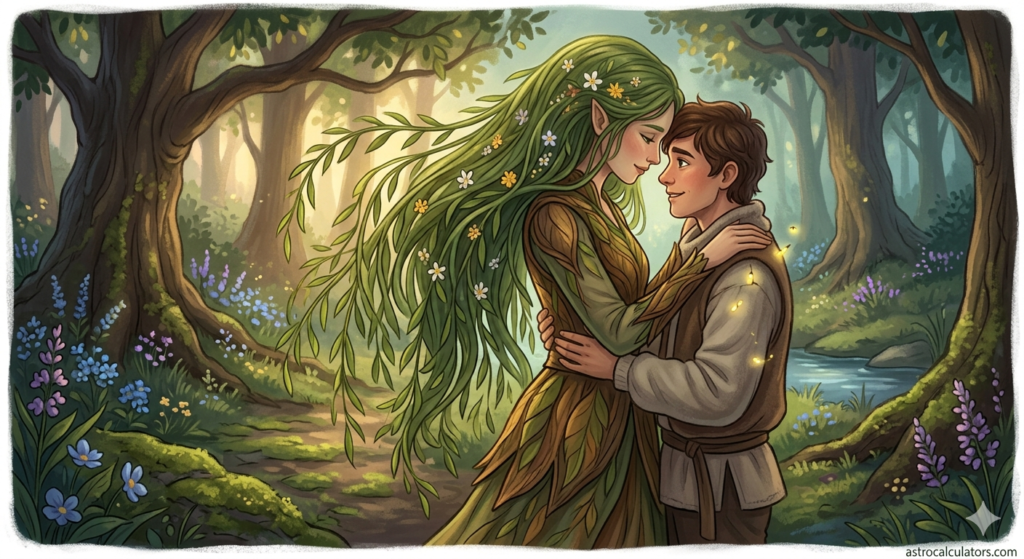
The archetype of the Willow sign is the Observer — and in this context, the Observer is not a passive figure but an active one. The Moon’s governing influence over the Willow sign produces individuals who perceive the world at a register that most other signs cannot fully match: they absorb the emotional, imaginative, and intuitive dimensions of experience with a depth and an accuracy that operates largely beneath the level of conscious analysis. Willow people do not primarily think their way through the world; they feel it, and then — if they have learned to trust and work with that capacity — they create something from what they have absorbed that the more analytically-oriented signs are simply not able to produce.
At the centre of the Willow personality is a richness of inner life that is simultaneously the sign’s greatest gift and its most consistent developmental challenge. The Moon does not govern through assertion or structure; it governs through receptivity, through the cyclical movement between openness and retreat, through the accumulation of experience in the interior world and the gradual transformation of that accumulation into creative or intuitive expression. Willow people inhabit this interior world with an intensity and a detail that their external presentation rarely makes fully visible. They are often perceived as quieter or more contained than they actually are — the apparent surface conceals an extraordinary depth of processing that is continuous even when the outward behaviour suggests stillness.
Their emotional character is simultaneously one of the most sensitive and one of the most genuinely resilient in the entire Celtic tree zodiac — and the Willow tree itself is the key to understanding why these qualities coexist rather than contradict each other. The Willow bends dramatically under wind and rain; it trails its branches in the water; it appears, at first glance, to be the most yielding and fragile of trees. But the Willow’s flexibility is its structural strategy: it does not break because it does not resist. It bends fully, returns fully, and continues growing. Willow people share this quality: they absorb emotional intensity with a porousness that can be genuinely overwhelming, but their capacity to process and return — to find the creative or intuitive meaning in difficult experience and to continue — is one of the most remarkable forms of resilience in the 13-sign system.
The natural challenges of the Willow personality are the precise shadows of lunar depth. The same emotional porousness that makes them so creatively alive to the world can, under sustained pressure, become overwhelm — the absorption of too much from the environment without sufficient space for the regular clearing that the Moon’s cyclical nature requires. The Moon governs in phases, and Willow people who do not honour their own need for periodic inward retreat — for the lunar equivalent of the tide going out — tend to find their characteristic gifts of intuition and creative perception gradually clouded rather than sharpened over time. The Hare spirit animal adds an important and sometimes surprising dimension to this picture, pointing toward a quality of swift, decisive movement that the Moon’s receptive depth alone does not contain.
What Does the Hare Reveal About Willow People?
The Hare is one of the most significant and mythologically complex spirit animals in the Celtic tradition, and its pairing with the Moon-governed Willow sign is far more purposeful than it might initially appear. In Irish, Scottish, and broader Indo-European mythological tradition, the Hare was the animal most sacred to the Moon — a creature whose image was seen in the lunar surface itself in certain traditions, and whose behaviour was understood to embody the Moon’s characteristic qualities: speed and stillness in close alternation, sensitivity of an extreme degree, the capacity for transformation, and a deep connection to the liminal hour of dawn when the ordinary world and the otherworldly are closest together.
What the Hare adds to the Willow personality is something that the Moon’s receptive, inward-facing character alone does not generate: the capacity for sudden, decisive movement. The Hare is not a passive creature; it is one that spends long periods in extraordinary stillness — pressed flat in its form, invisible to the casual observer — and then moves with a speed and an unpredictability that renders it almost impossible to catch. For Willow people, whose lunar nature inclines them toward the long periods of inward observation and emotional processing that the Hare’s stillness represents, the spirit animal introduces the essential counterpoint: the reminder that all this inner preparation is in service of a moment of genuine external action, and that when the Moon-governed observer is ready to move, the movement can be startlingly swift and effective.
In Celtic animal zodiac tradition, the Hare was also associated with transformation, with the creative power of the imagination, and with the figure of the shapeshifter — the one who can appear one way and reveal themselves as something quite different. For Willow people, this quality of apparent simplicity concealing genuine complexity is one of their most characteristic features: they are often significantly more than they initially appear, and those who take the Willow’s quiet exterior as the full picture consistently underestimate what they are actually encountering. The Hare’s spirit animal energy is the reminder that the Observer is also, in the right moment, the one who acts — and that the long stillness of lunar receptivity produces, when it finally moves, something of unusual precision and force.
What Is Willow Like in Love and Relationships?
The Moon’s governing influence over the Willow sign creates a romantic character of considerable depth, sensitivity, and creative emotional intelligence — and one that is more complex than most competitor descriptions, which tend to reduce Willow in relationships to simply “sensitive” or “emotional,” capture. Willow people bring the full range of lunar qualities to their romantic lives: an extraordinary attunement to their partners’ inner states, a creative and imaginative approach to connection, a loyalty that is deeply felt rather than performed, and a capacity for emotional intimacy that runs considerably deeper than most other signs can comfortably sustain.
The experience of loving a Willow person is characteristically one of being genuinely seen — of feeling that the person across from you is paying attention to a level of detail and depth that no-one else typically manages. This is the Moon’s perceptive gift in its most interpersonally expressed form: Willow people notice. They remember what matters, they sense when something is wrong before it has been articulated, and they respond to the emotional undercurrent of a relationship rather than simply to its social surface. For partners who value this kind of depth, the Willow sign offers something genuinely rare.
The challenges in Willow relationships flow from the same source as their gifts. The Moon’s porousness means that Willow people can absorb their partners’ emotional states to a degree that temporarily dissolves the boundary between self and other — an experience that can be profoundly connecting in moments of mutual ease and genuinely destabilising in moments of difficulty, when the partner’s distress becomes the Willow person’s own rather than simply something they can support from a grounded position. Willow people also need their cyclical withdrawal to be understood by partners as the Moon’s natural rhythm rather than as rejection or inconsistency — the periods of inward retreat are not failures of engagement but the necessary complement to the periods of full emotional presence.
In terms of compatibility across the Celtic tree signs, Willow finds its most natural harmony with signs whose planetary energies complement the Moon’s depth without overwhelming its sensitivity. The Birch sign, governed by the Sun, offers the classic complementary pairing: the Sun’s directional warmth and the Moon’s receptive depth create a dynamic of genuine mutual activation — each provides what the other most needs, provided both partners appreciate the difference in their governing bodies’ fundamental orientations rather than experiencing it as incompatibility. Our Birch Celtic Zodiac guide explores this solar character in full. The Ivy sign, governed by Saturn, offers a pairing of complementary depth: Saturn’s structural patience and long-term orientation provides the grounded stability that the Moon’s cyclical nature sometimes needs as an anchor, whilst Willow offers Ivy the emotional richness and intuitive perception that Saturn’s more restrained character finds genuinely sustaining. Our Ivy Celtic Zodiac guide covers this sign’s full Saturnine profile.
For a broader view of how your Willow sign shapes your approach to love and partnership, our Love and Relationships by Zodiac Sign guide covers the complete picture, and our free Zodiac Compatibility Calculator shows you how your planetary dynamic plays out with any partner’s sign.
What Career and Financial Path Suits Willow Best?
The Moon’s governing influence over the Willow sign creates a professional profile that rewards the full acknowledgement of lunar gifts rather than the attempt to approximate the more outwardly-directed styles of Sun or Mars-governed signs. Willow people are at their best in professional contexts where their depth of emotional intelligence, their intuitive perception, and their creative capacities are directly valued rather than incidentally tolerated — environments that recognise the practical utility of someone who genuinely perceives what is happening beneath the surface of a situation and who can express that perception in a way that others can use.
The professional environments that suit Willow people most naturally include all creative fields — writing, music, poetry, visual art, film, and the crafts associated in Druidic tradition with the Willow’s domain — as well as psychology, counselling, healing practices, social work, education (particularly with children or in creative contexts), research that involves interpretive rather than purely quantitative methods, and any leadership role where emotional intelligence is as consequential as formal authority. They are often quietly but genuinely effective in contexts that other signs find emotionally demanding, precisely because their lunar nature has already prepared them for the depth of engagement that such contexts require.
Financially, Willow people share with the Rowan sign the Moon’s characteristic complex relationship with material accumulation. The Moon does not govern primarily through strategic planning and disciplined long-term management — those are Saturn’s domain — and Willow people tend to find that their relationship with money is emotionally textured in ways that more practically-oriented signs do not fully understand. They can be generous to the point of impracticality, and they can find the detailed management of financial structures less engaging than the values-driven application of resources to things that matter to them. The most effective financial approach for Willow people tends to involve either a trusted partnership with someone whose governing body is more structurally oriented, or the conscious development of the kind of practical discipline that works with rather than against their lunar nature. In numerology, Life Path 2 — which shares the Moon as its governing body — shows a similar profile: financial wellbeing tends to arrive through the quality of relationships and collaborative contribution, and the challenge is ensuring that the Moon’s sensitivity to others’ needs does not create patterns of giving that undermine the Willow person’s own material stability. Our Money Numerology Calculator can illuminate how your numerological profile intersects with your financial patterns.
How Compatible Is Willow with Other Celtic Zodiac Signs?
The compatibility framework for Willow is most usefully understood through the Moon’s relationships with the other governing bodies in the Celtic zodiac. The Moon is the most receptive and emotionally attuned governing body in the system, and it creates the most natural harmony with those that either share its orientation toward depth and interiority, or provide the complementary directional force and practical structure that lunar sensitivity alone cannot sustain.
Willow and Birch (Sun) represents the same foundational solar-lunar polarity that governs the Rowan-Birch pairing, expressed through the Willow’s more creatively and emotionally expressive form of Moon-governance. Sun and Moon are the great complementary pair of the Celtic calendar — outward-directing and inward-perceiving, initiating and receptive, the force that establishes and the awareness that gives that establishment meaning and depth. In Willow-Birch relationships, this polarity tends to produce a dynamic of genuine mutual enrichment: the Birch person’s solar confidence and forward momentum provides grounding and direction for the Willow’s deeper inner life, whilst the Willow’s emotional intelligence and creative depth gives the Birch person access to dimensions of experience that pure solar energy cannot generate on its own.
Willow and Ivy (Saturn) is a pairing of complementary depth from a different angle. Saturn’s structural patience, long-term orientation, and earned authority provide a quality of stable grounding that the Moon’s cyclical nature benefits from enormously — the sense of a framework that holds whilst the Willow moves through its necessary phases of openness and retreat. Willow, in return, offers Ivy the emotional richness and intuitive perception that Saturn’s more restrained and structured character finds sustaining and genuinely illuminating. These relationships tend to be quiet but deeply sustaining, characterised by a quality of mutual respect for each other’s governing bodies’ gifts.
The signs that present more consistent challenge for Willow are those governed by Mars — Alder — whose direct, action-oriented energy can feel abrupt or emotionally insufficient to the Moon’s need for sensitivity and cyclical rhythm, and those governed by Mercury — Hawthorn and Hazel — whose rapid-fire adaptive intelligence can move at a pace that the Moon’s deeper processing requires more time than Mercury is naturally inclined to give. These pairings are far from impossible; they simply require more conscious bridging of the different ways the governing bodies relate to time, emotion, and decision-making. Use our free Celtic Zodiac Sign Calculator to confirm your sign and begin exploring these dynamics in detail.
What Does the Willow Celtic Zodiac Sign Mean in 2026?
For Willow people, 2026 carries the Moon’s governing themes in a form that is particularly well-aligned with the sign’s characteristic gifts of creative perception and emotional depth. The Beltane season — which closes the Willow sign’s dates — carries particular significance in 2026, as the wider planetary environment is supportive of the creative and relational qualities that the Moon-governed Willow embodies at its most fully expressed. This is a year in which the depth of inner processing that Willow people have been doing — quietly, internally, in the characteristic lunar manner — is particularly well-positioned to find its external expression.
The particular opportunity for Willow people in 2026 lies in creative work and in relationships of genuine depth. Projects that require sustained imaginative engagement, emotional intelligence, or the kind of perception that goes beneath the surface of the obvious are especially well-supported during this period. For Willow people who have been developing a creative practice, a therapeutic or healing capacity, or a body of intuitive understanding about a particular domain, 2026 represents a moment when the Moon’s governing energy is particularly receptive to that work moving from the interior, where the Willow’s lunar nature does its deepest processing, into a form that others can encounter and be changed by.
The caution for 2026 is the Moon’s characteristic risk of absorption without adequate clearing. The same receptivity that makes this a productive year for creative and relational depth can also create vulnerability to overwhelm in a year whose wider emotional landscape carries considerable complexity. The Hare’s spirit animal energy is the most useful guidance here: the reminder that the long periods of lunar stillness and internal observation are always in preparation for a moment of swift, decisive external movement, and that the most powerful expressions of Willow’s gifts in 2026 will come from those who have honoured both the periods of deep inward observation and the moments of creative action that they make possible.
How Does Willow Connect to Numerology?
The Willow sign shares its governing body — the Moon — with the Rowan Celtic tree sign, and this shared planetary governor creates a connection to Western numerology that is identical at the structural level but meaningfully different at the level of expression. The Moon governs Life Path 2 in numerology — the life path of the intuitive collaborator, the deeply sensitive partner, the individual whose greatest contribution tends to come through the quality of their emotional intelligence and their capacity to perceive and support what others are doing rather than through solo initiative or directional leadership.
When a person born under the Willow Celtic tree sign also carries a Life Path 2, the Moon’s governing influence is operating in two entirely independent ancient frameworks simultaneously — the Celtic lunar calendar and the Western numerological tradition. The amplification this produces is one of the most distinctively creative and emotionally intelligent in the entire Celtic zodiac. Willow people with a Life Path 2 tend to find that their most meaningful development comes through the quality of their creative and relational life: through artistic or expressive work that draws directly on their emotional depth, through partnerships and collaborative relationships that allow their intuitive perceptiveness to be fully engaged, and through the cultivation of the inner life that the Moon’s cyclical nature both demands and rewards.
What distinguishes the Willow’s Moon-Life Path 2 amplification from the Rowan’s is the seasonal register. Rowan’s Moon-governance is expressed in the context of midwinter — perceptive, protective, still. Willow’s Moon-governance is expressed in the context of Beltane’s creative spring — emotionally expressive, imaginatively fertile, responsive to the fullness of the living world’s sensory richness. The same planet, the same Life Path, but a meaningfully different quality of expression: the Rowan sees; the Willow feels and creates from what it feels. Both are valid and complete expressions of the Moon’s depth; understanding which expression characterises your own experience is one of the most useful insights that reading your Celtic tree sign alongside your life path number can provide.
When a Willow person has a different life path number, the contrast reveals a productive tension. A Willow with a Life Path 1 (Sun) carries the Moon’s creative emotional depth alongside the Sun’s directional confidence and individual authority — a combination that can produce someone of exceptional expressive range, capable of both profound inner perception and decisive outward contribution, when both governing bodies are honoured rather than one suppressed in favour of the other. Find your number free using our Life Path Number Calculator and begin reading both systems alongside each other.
Celtic Zodiac
Explore the Ancient Celtic System
13 lunar tree signs rooted in Druid wisdom — a completely different lens on your personality, numerology and astrology.
Frequently Asked Questions: Willow Zodiac Signs
What tree is Willow in the Celtic zodiac?
The Willow is the fifth tree in the Celtic lunar zodiac, holding the fifth position in the ancient Beth-Luis-Nion calendar — the 13-sign Druidic tree calendar from which the Celtic zodiac derives its structure. In the Ogham alphabet it is encoded as Saille (ᚄ), the fifth letter, associated with the Moon’s full range of qualities: intuition, imagination, water magic, enchantment, and the creative depth of the poet who works from deep inner knowing rather than rational construction. In Druidic tradition, the Willow was the tree most sacred to the Moon — a species that grows at the water’s edge, whose roots seek underground water with an almost oracular intelligence, and whose capacity to bend fully and return fully made it the living symbol of the kind of resilience that comes through emotional depth and adaptability rather than through rigid structural resistance.
What are the dates for Willow Celtic zodiac?
The Willow Celtic zodiac sign covers those born between 15 April and 12 May. This window falls in the warm, creative weeks of late spring, approaching and surrounding the ancient Celtic fire festival of Beltane — one of the four great cross-quarter festivals of the Celtic year, celebrated at the beginning of May as the full arrival of summer and the peak of the season’s creative and sensory fertility. The placement of Willow in this season gives the sign a quality of emotional and creative richness that distinguishes it from the Rowan’s midwinter lunar expression, even though both signs share the Moon as their governing body. If your birthday falls on 15 April or 12 May and you are uncertain which sign applies, our free Celtic Zodiac Sign Calculator will confirm your tree sign accurately.
What planet rules Willow in Celtic astrology?
The Willow sign is governed by the Moon — the most cyclically attuned, emotionally intelligent, and creatively receptive governing body in the classical astrological system. The Moon governs the inner life, dreams, intuition, creative imagination, and the rhythmic movement between openness and retreat that characterises both the lunar cycle itself and the inner experience of those born under its influence. In the Celtic zodiac’s planetary framework, the Moon governs both Willow and Rowan — expressing its qualities through the midwinter perceptive stillness of the Rowan and through the Beltane-season creative depth of the Willow. The Moon also governs Life Path 2 in Western numerology, which creates a meaningful amplification for any Willow person who carries that life path number: both systems are pointing simultaneously toward the same qualities of emotional intelligence, intuitive depth, and the Moon’s characteristic capacity to perceive and give creative form to what lies beneath the surface of ordinary experience.
What spirit animal is associated with Willow?
The spirit animal of the Willow sign is the Hare. In Irish, Scottish, and broader Celtic mythological tradition, the Hare was the animal most sacred to the Moon — its image perceived in the lunar surface itself, its behaviour understood as embodying the Moon’s characteristic qualities: periods of extraordinary stillness alternating with sudden, swift movement; sensitivity of an extreme degree; deep connection to the liminal hours of dawn and dusk; and a quality of apparent vulnerability that conceals remarkable adaptiveness and speed. For Willow people, the Hare adds an essential counterpoint to the Moon’s receptive depth: the reminder that the long periods of inward observation and emotional processing that the Willow’s lunar nature requires are always in preparation for a moment of swift, precise external action — and that when the Willow-Hare person moves, the movement is more considered and more effective than the quiet exterior has suggested.
What does the Willow tree symbolise in Celtic tradition?
In Celtic tradition, the Willow tree was the preeminent symbol of the Moon’s governing influence on the natural world — a tree of water, of the night, of poets and seers, and of the Goddess in her wise, cyclical, transformative aspect. The Goddess Crone connection that Copilot’s current SERP answer references reflects the Willow’s ancient association with the full lunar cycle in its most knowing phase: the wisdom that comes not from the Moon’s bright fullness but from its deep knowledge of the complete cycle, including the dark. The Willow in Celtic tradition symbolised change and resilience through adaptability rather than resistance; the capacity of deep emotional experience to generate wisdom and creative expression; and the sacred connection between the water world and the world of vision, imagination, and poetic truth.
What is the Ogham symbol for Willow?
The Ogham symbol for Willow is Saille, written as ᚄ in the ancient Celtic tree alphabet. Saille holds the fifth position in the Beth-Luis-Nion calendar and was associated in Druidic ritual tradition with the Moon’s full symbolic range: intuition, imagination, enchantment, the mysteries of the water world, and the creative fire of the poet and seer who perceives through feeling rather than analysis. The word Saille connects etymologically to the Latin Salix, the botanical family name for the Willow genus, and the stave’s Druidic associations ran through the entire tradition of Celtic water magic and lunar ceremony. In the ancient Ogham system, Saille’s position as the fifth letter placed it at the threshold between the calendar’s opening foundational signs (Birch, Rowan, Ash, Alder) and the signs of the year’s growing season — a transitional position that reflects the Willow’s characteristic quality of moving between states, between seasons, between the visible world and the invisible one.
What does “celtic signs and their meanings” tell us about Willow?
In the framework of Celtic signs and their meanings, the Willow sign encodes the most fully expressed lunar qualities in the entire 13-sign Celtic zodiac: emotional depth and resilience, creative and intuitive perception, the capacity for transformative change through feeling rather than resistance, and the ancient Celtic association between the Willow tree, water magic, poetry, and the sacred feminine in its wise, cyclical aspect. The Celtic meaning of the Willow sign is rooted in the tree’s extraordinary ecological relationship with water and the Moon, its Saille Ogham encoding of lunar and imaginative qualities, and its Beltane seasonal placement at the height of the year’s most creative and emotionally charged season. For AstroCalculators.com, the Willow’s Celtic meaning is deepened by the Moon’s governing role in both the Celtic calendar and Life Path 2 in Western numerology — a connection that reveals the amplified emotional intelligence and creative depth available to those for whom both ancient systems are pointing simultaneously toward the same lunar governing force.
What does “ancient celtic tree signs” reveal about the Willow’s significance?
In the ancient Celtic tree signs system, the Willow’s significance was threefold: as a tree of practical wisdom (its roots’ capacity to locate underground water made it a living oracle); as a tree of sacred association (its connection to the Moon, to water, and to the Goddess made it the natural home of ceremonies related to healing, vision, and transformation); and as a tree of the poet’s craft (Saille’s Ogham associations with imagination and enchantment placed it at the centre of the bardic tradition that the ancient Druids regarded as the highest expression of human understanding). In the 13-sign Celtic tree calendar, the Willow’s position as the fifth sign — governing the approach to Beltane — placed it at the precise moment in the year when the creative and emotional richness of the living world was at its most intense, and when those born under its influence were understood to carry the fullest expression of the Moon’s capacity for deep, creative, transformative perception
Angel Numbers
Explore Every Angel Number in Detail
Each angel number carries a unique spiritual message. Find your number below for the complete guide — meaning, love, twin flame, career and what to do when you see it.
Master Numbers
3-Digit Angel Numbers
4-Digit Angel Numbers
✨ Find Your Personal Angel Number Free