Quick Answer
What Is Pythagorean Numerology?
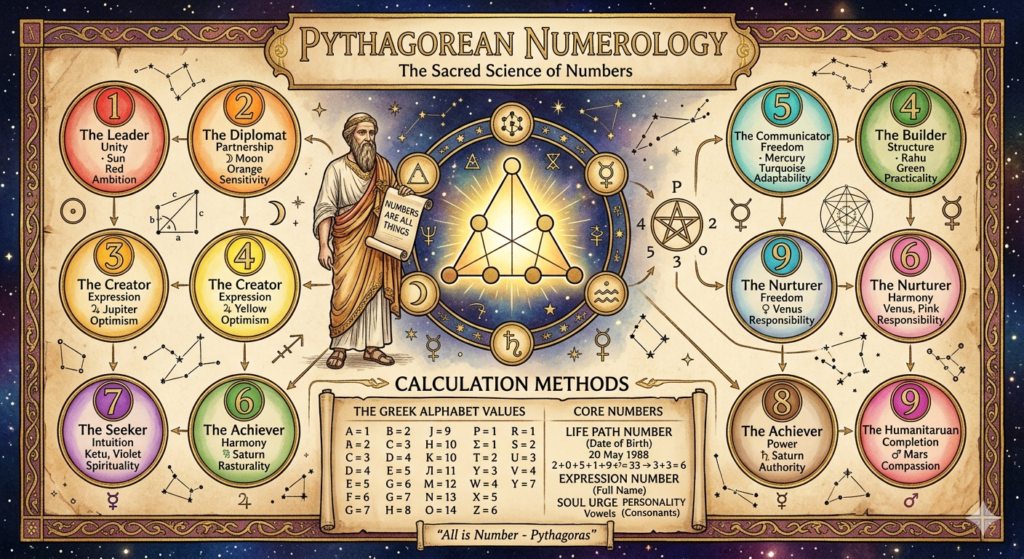
Pythagorean numerology is the most widely used numerology system in the Western world — a method of assigning numerical values to the letters of your name and the digits of your birth date to reveal core personality traits, life purpose and destiny patterns. Created by the Greek philosopher and mathematician Pythagoras around 570–495 BCE, it uses the numbers 1 through 9 alongside master numbers 11, 22 and 33 to produce five core numbers: the Life Path, Expression, Soul Urge, Personality and Birth Day numbers. It is the foundation of virtually all modern Western numerology practice.
There is a moment, well documented in the ancient sources, when Pythagoras looked at the universe and concluded that it was made of numbers. Not that numbers described the universe. Not that numbers were a useful metaphor for the universe. That numbers were the actual substance of reality — that the mathematical relationships governing the movement of planets, the harmony of musical intervals and the proportions of living things were not imposed on nature from outside but were the fundamental language in which nature was written.
This was not a mystical intuition. Pythagoras was one of history’s most rigorous mathematical minds — the person who formalised the theorem that still bears his name, who discovered the mathematical basis of musical harmony, who established the first school in the Western tradition that combined mathematics, philosophy and the study of what we would now call the nature of consciousness. When Pythagoras said the universe was made of numbers, he meant it as a precise empirical claim based on observation and mathematical reasoning.
The numerology system that carries his name is the direct expression of this insight applied to human life. If numbers are the language of reality, then the numbers present in your birth date and your name — the two most fundamental data points of your individual existence — must carry information about who you are, what you are here to do and what patterns will most consistently shape your experience. Pythagorean numerology is the 2,500-year-old method of reading that information.
This guide covers everything you need to understand about Pythagorean numerology — where it came from, how it works, what each number means, how to calculate your own core numbers and how it differs from the Chaldean system that is its primary alternative.
Find Your Pythagorean Numerology Numbers — Free Name Numerology Calculator
What Did Pythagoras Discover About Numbers?
Pythagoras of Samos was born around 570 BCE on the Greek island of Samos, off the coast of what is now western Turkey. He was one of the most widely travelled and intellectually adventurous figures of the ancient world — studying in Egypt, where he spent up to 22 years learning the Chaldean number traditions and Egyptian priestly knowledge, in Babylon, where he encountered the mathematical traditions of Mesopotamia, and eventually in Croton in southern Italy, where he established the Pythagorean Brotherhood — a community of scholars, philosophers and mathematicians dedicated to the systematic study of number, music, astronomy and the nature of the soul.
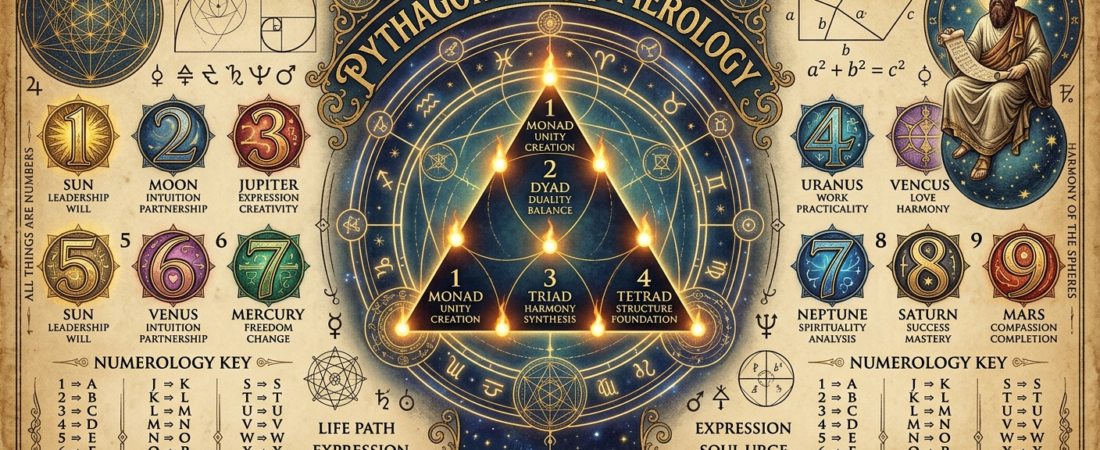
What Pythagoras discovered — or, more precisely, what he systematised and extended from the traditions he encountered in his travels — was that numbers were not merely tools for counting and measurement. They were vibrational qualities, each carrying a specific energy that expressed itself consistently across different domains of reality. The number 1 expressed itself identically in music (as the fundamental tone from which all other tones derive), in geometry (as the point from which all other figures emerge) and in human nature (as the principle of individual identity and self-directed will). The number 2 expressed itself as duality, harmony and the relational principle — in music as the octave, in geometry as the line, in human nature as the capacity for partnership and cooperation. Each number carried a quality that was genuinely its own and genuinely universal.
The application of this insight to human life was the origin of what we now call Pythagorean numerology. If each number carries a specific vibrational quality, and if the numbers present in a person’s birth date and name are not random but carry the same informational content as any other number in the universe, then those numbers reveal something real and specific about who that person is. The Life Path Number derived from the birth date reveals the fundamental trajectory of a person’s journey through life. The name numbers reveal how that fundamental nature expresses itself in personality, inner desire and the impression made on the world. The Pythagorean system provides the framework for reading this information with precision and depth.
The Pythagorean school was not merely academic. Members lived by a set of philosophical and ethical principles — the Pythagorean way of life — that integrated mathematical study with personal development, spiritual practice and the pursuit of wisdom in its most comprehensive sense. Numbers, for Pythagoras and his followers, were not an abstract intellectual interest. They were a path of genuine self-knowledge. This is the tradition that modern Pythagorean numerology carries forward.
How Does Pythagorean Numerology Work?
Pythagorean numerology works by converting the letters of your name and the digits of your birth date into numbers and then reducing those numbers through a specific process to reveal five core numbers — each illuminating a different dimension of your identity, purpose and potential.
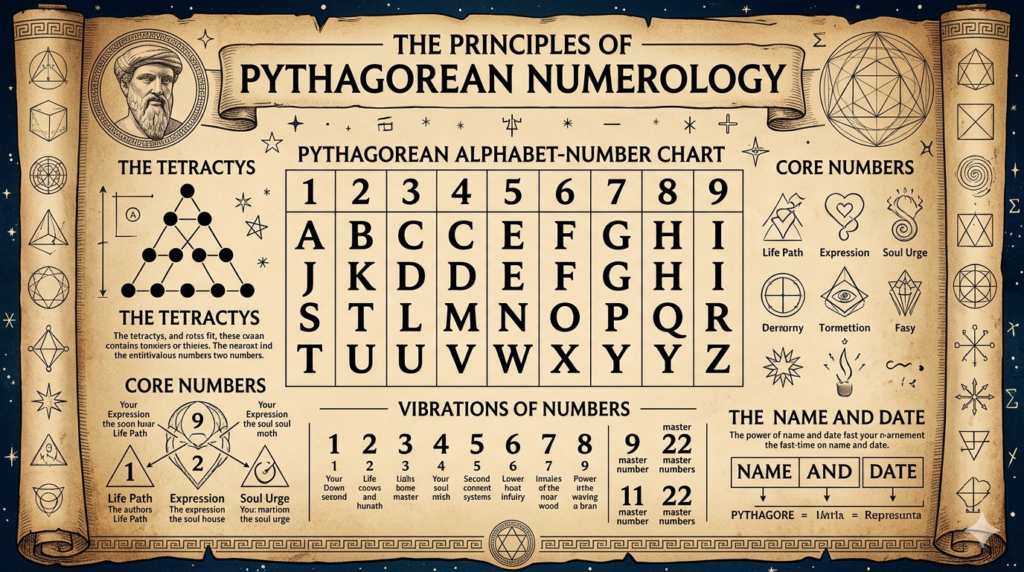
The conversion system is called the Pythagorean number chart — a table that assigns a number from 1 to 9 to each letter of the alphabet in a sequential pattern:
1: A, J, S 2: B, K, T 3: C, L, U 4: D, M, V 5: E, N, W 6: F, O, X 7: G, P, Y 8: H, Q, Z 9: I, R
This assignment is sequential — the alphabet maps onto the numbers 1 through 9 in order, repeating three times to cover all 26 letters. This is the defining characteristic of the Pythagorean system and the primary way it differs from the Chaldean system, which uses a non-sequential assignment based on the vibrational qualities the Chaldean tradition attributed to each number.
The five core numbers produced by this system are:
The Life Path Number — calculated from your complete birth date (month, day and year each reduced to a single digit or master number, then added together and reduced again). The Life Path Number is the most important number in your Pythagorean chart. It describes your fundamental purpose, the central lessons of your lifetime and the natural strengths and challenges that define your journey. It is the number most people encounter first when they begin exploring numerology.
The Expression Number (also called the Destiny Number) — calculated from the full birth name as it appears on your birth certificate, with every letter converted to its Pythagorean number value, all digits added and reduced to a single digit or master number. The Expression Number reveals how you engage with the world — your natural talents, the way you present yourself and the outer expression of your inner nature.
The Soul Urge Number (also called the Heart’s Desire Number) — calculated from the vowels of your full birth name only. The Soul Urge Number reveals your innermost motivation — what you genuinely need at the level of deep desire, what drives you beneath the surface of conscious intention, the hunger that shapes your choices even when you are not fully aware of it.
The Personality Number — calculated from the consonants of your full birth name only. The Personality Number reveals how you appear to others — the first impression you make, the qualities people see before they know you well, the outer layer of your character that the world encounters first.
The Birth Day Number — simply the day of the month on which you were born, reduced to a single digit if necessary (except for master numbers 11 and 22). The Birth Day Number reveals a specific gift or ability you brought into this lifetime — a particular talent or quality that is available to you with relative ease.
Together these five numbers form your complete Pythagorean numerology chart — a detailed portrait of who you are at multiple levels, how you engage with the world and what your life is fundamentally oriented toward.
What Is the Pythagorean Numerology Letter Chart?
The Pythagorean letter chart is the foundation of the entire system — the conversion table that translates the letters of your name into numbers. Understanding how it works and why it is constructed the way it is clarifies both the mechanics and the philosophy of Pythagorean numerology.
The chart assigns numbers 1 through 9 to the 26 letters of the English alphabet in strict sequential order:
| Number | Letters |
|---|---|
| 1 | A, J, S |
| 2 | B, K, T |
| 3 | C, L, U |
| 4 | D, M, V |
| 5 | E, N, W |
| 6 | F, O, X |
| 7 | G, P, Y |
| 8 | H, Q, Z |
| 9 | I, R |
To use this chart, take your full birth name as it appears on your birth certificate and assign the number value to each letter. Add all the numbers together. Reduce the total to a single digit by adding the digits of the sum — unless you arrive at 11, 22 or 33, which are master numbers and are not reduced further.
Example: The name SARAH S=1, A=1, R=9, A=1, H=8 Total: 1+1+9+1+8 = 20 Reduce: 2+0 = 2 Expression Number: 2
For the Soul Urge Number, use only the vowels (A, E, I, O, U): SARAH vowels: A=1, A=1 Total: 1+1 = 2 Soul Urge Number: 2
For the Personality Number, use only the consonants: SARAH consonants: S=1, R=9, H=8 Total: 1+9+8 = 18 = 1+8 = 9 Personality Number: 9
“To see how your personal Pythagorean Life Path Number shapes your wealth potential, earning style and financial blind spots, use our free Money Numerology Calculator.”
What Is the Difference Between Pythagorean and Chaldean Numerology?
Pythagorean and Chaldean numerology are the two most significant Western numerology systems and understanding the difference between them clarifies both their respective strengths and the philosophical assumptions that underlie each.
Origin and history: Pythagorean numerology was systematised by Pythagoras of ancient Greece around the 6th century BCE, drawing on and extending the mathematical and mystical number traditions he encountered during his studies in Egypt and Babylon. Chaldean numerology originates in ancient Babylon — the Chaldean empire — and predates Pythagorean numerology by several centuries, making it arguably the older system. Pythagorean numerology is sometimes called Modern Numerology or Western Numerology. Chaldean is sometimes called Ancient Numerology or Mystic Numerology.
The letter chart: This is the most practically significant difference. The Pythagorean system assigns numbers 1 through 9 to letters in strict alphabetical sequence. The Chaldean system assigns numbers based on the vibrational quality the Chaldean tradition attributed to each sound — a non-sequential assignment that means the same letter can carry a different number in Chaldean than in Pythagorean. Chaldean also does not use the number 9 in its letter assignments (considering 9 too sacred for this purpose), using only numbers 1 through 8.
What name is used: Pythagorean numerology traditionally uses the full birth name as it appears on the birth certificate — the legal name given at birth. Chaldean numerology uses the name a person currently goes by — their commonly used name — on the basis that the name people actively use carries their current vibrational energy more accurately than their birth name.
Number range: Pythagorean numerology uses numbers 1 through 9 plus master numbers 11, 22 and 33. Chaldean numerology uses numbers 1 through 52 without reducing compound numbers to single digits, giving compound numbers their own distinct meanings.
Which is more accurate: Both systems have genuine depth and genuine practitioners who consider them reliable. Pythagorean numerology is more widely taught, more systematically developed in modern practice and more accessible for beginners. Chaldean is considered by many professional numerologists to be more nuanced and more demanding to master. The most honest answer is that accuracy depends on the skill and depth of the practitioner rather than on the system alone.
Your free Name Numerology Calculator uses the Pythagorean system and calculates your Expression, Soul Urge and Personality numbers instantly.
How Do You Calculate Your Pythagorean Numerology Numbers?
Calculating your core Pythagorean numerology numbers requires your full birth name as it appears on your birth certificate and your complete date of birth. Here is the step-by-step process for each number.
Life Path Number — from your birth date:
Write your birth date as month, day and year. Reduce each component separately to a single digit (or master number). Add the three results together and reduce again.
Example: Born July 14, 1990 Month: July = 7 Day: 14 = 1+4 = 5 Year: 1990 = 1+9+9+0 = 19 = 1+9 = 10 = 1+0 = 1 Final: 7+5+1 = 13 = 1+3 = 4 Life Path Number: 4
If at any reduction step you reach 11, 22 or 33 — stop. These are master numbers and are not reduced further.
Use the free Life Path Calculator for instant accurate calculation.
Expression Number — from all letters of full birth name:
Convert every letter to its Pythagorean number using the chart above. Add all numbers together. Reduce to a single digit or master number.
Soul Urge Number — from vowels only:
Identify all vowels (A, E, I, O, U) in your full birth name. Convert each to its Pythagorean number. Add and reduce.
Personality Number — from consonants only:
Identify all consonants in your full birth name. Convert each to its Pythagorean number. Add and reduce.
Birth Day Number — from day of birth:
Simply take the day of the month you were born. If it is a two-digit number, reduce it (unless it is 11 or 22). Born on the 23rd: 2+3 = 5. Birth Day Number: 5.
What Do the Pythagorean Numbers 1 Through 9 Mean?
Each number in the Pythagorean system carries a specific and consistent vibrational quality that expresses itself across all five core numbers. The meaning of your Life Path 3 and the meaning of your Expression 3 share the same essential quality — creative self-expression, communication and the impulse toward joy — expressed through different dimensions of your character.
Number 1 — Leadership, Independence, Initiation The number 1 is the number of the individual will — of self-directed action, originality and the courage to begin. People with prominent 1 energy are natural initiators who thrive when given genuine autonomy and who bring a quality of pioneering confidence to whatever they commit to. The shadow of 1 is the arrogance that comes when the drive for independence becomes an inability to receive or collaborate.
Number 2 — Partnership, Balance, Diplomacy The number 2 is the number of relationship — of the sensitivity that makes genuine collaboration possible and the patience that allows trust to develop at its natural pace. People with prominent 2 energy are natural peacemakers whose gift is the ability to find the common ground between apparently opposing positions. The shadow of 2 is dependency and the self-erasure that comes from prioritising harmony over honest self-expression.
Number 3 — Creativity, Expression, Joy The number 3 is the number of creative self-expression — of the impulse to communicate, create and bring beauty and delight into the world through the specific medium of one’s individual voice. People with prominent 3 energy are natural communicators, storytellers and artists whose gift is making the world feel more alive. The shadow of 3 is superficiality and the scattering of gifts across too many directions to develop genuine depth in any.
Number 4 — Structure, Discipline, Foundation The number 4 is the number of the builder — of the patient, methodical, disciplined work that produces lasting foundations. People with prominent 4 energy are natural organisers and builders whose gift is the capacity to take vision and translate it into enduring reality through systematic effort. The shadow of 4 is rigidity and a relationship with work that crowds out the emotional and relational dimensions of life.
Number 5 — Freedom, Change, Adventure The number 5 is the number of the free spirit — of movement, adaptability and the restless hunger for experience that refuses to settle before the full range of what life offers has been explored. People with prominent 5 energy are natural travellers, changemakers and communicators whose gift is the ability to adapt to anything and thrive in change. The shadow of 5 is inconsistency and the inability to develop the depth that only sustained commitment produces.
Number 6 — Nurturing, Responsibility, Home The number 6 is the number of the caretaker — of the love that expresses itself through practical service, the creation of beauty and the faithful tending of relationships and community. People with prominent 6 energy are natural nurturers and healers whose gift is the capacity to create environments in which others feel genuinely cared for. The shadow of 6 is self-sacrifice and the martyr dynamic that develops when the giving flows entirely outward without reciprocal care flowing in.
Number 7 — Wisdom, Introspection, Spiritual Depth The number 7 is the number of the seeker — of the inner life, the search for truth and the willingness to go beneath the surface of things to find what is genuinely real. People with prominent 7 energy are natural philosophers, researchers and spiritual seekers whose gift is the depth of perception that comes from a genuine comfort with solitude and introspection. The shadow of 7 is isolation and the cynicism that comes from maintaining such high standards for genuine understanding that connection becomes difficult.
Number 8 — Abundance, Power, Mastery The number 8 is the number of worldly mastery — of the ambition, strategic intelligence and executive capacity that produces material achievement at scale. People with prominent 8 energy are natural leaders in business, finance and positions of genuine authority whose gift is the ability to organise resources and people in service of significant goals. The shadow of 8 is the abuse of power and the materialism that mistakes financial achievement for the fulfilment that genuine 8 energy actually seeks.
Number 9 — Completion, Wisdom, Humanitarian Service The number 9 is the number of the wise elder — the number that contains within it the accumulated learning of all the numbers that came before it and expresses that learning as genuine wisdom in service of the collective. People with prominent 9 energy are natural humanitarians whose gift is the capacity to understand and serve the broadest possible range of human experience. The shadow of 9 is the bitterness that comes when the giving is not received or the sacrifice is not appreciated.
What Are the Pythagorean Master Numbers 11, 22 and 33?
The Pythagorean system recognises three numbers that are not reduced to single digits in the final calculation — 11, 22 and 33. These are the master numbers, and they carry a specifically heightened level of potential, challenge and spiritual significance.
Master Number 11 is the Intuitive Visionary — carrying the doubled energy of 1 tempered by the sensitivity of 2, producing a nature of extraordinary intuitive perception and spiritual awareness. The Life Path 11 is called to bridge the inner and outer worlds, translating what they perceive at the level of genuine truth into forms that others can receive and use.
Master Number 22 is the Master Builder — carrying the visionary perception of 11 grounded in the structural discipline of 4, producing the rarest combination of spiritual vision and practical building capacity. The Life Path 22 is called to manifest genuinely significant things in the world — structures, systems and achievements that outlast the individual lifetime.
Master Number 33 is the Master Teacher — carrying the compassionate service of 6 elevated to its highest expression, combining the gifts of 11 and 22 in complete dedication to the upliftment of others. The Life Path 33 is the rarest and most demanding master number, calling for complete subordination of personal ambition to the work of serving humanity.
How Accurate Is Pythagorean Numerology?
Pythagorean numerology is not a predictive system in the way that weather forecasting or mathematical modelling is predictive. It does not tell you what will happen at a specific time or what decisions will produce specific outcomes. What it does — and what the people who engage with it seriously consistently report — is provide a framework of remarkable accuracy for understanding patterns of character, the recurring themes of a life and the fundamental orientation a person carries toward their own experience.
The accuracy of Pythagorean numerology, from the perspective of those who use it professionally, lies not in its ability to predict events but in its ability to describe tendencies with a precision that externally focused systems cannot access. A well-calculated Pythagorean chart will describe the central tensions of a person’s character — the gap between what they show the world (Personality Number) and what they most deeply want (Soul Urge Number), the difference between their fundamental nature (Life Path) and the way that nature is most naturally expressed (Expression Number) — with a specificity that consistently surprises people encountering their chart for the first time.
The most productive relationship with Pythagorean numerology is not as a fortune-telling system but as a framework for self-understanding — a structured way of asking the right questions about who you are, what you are genuinely here for and what patterns in your experience might be more deeply informed by your fundamental nature than by the apparent circumstances that seem to produce them
FAQs — Pythagorean Numerology
What are Pythagorean numbers?
In numerology, Pythagorean numbers are the single-digit numbers 1 through 9 plus the master numbers 11, 22 and 33 that form the complete number system used in Pythagorean numerology. Each carries a specific vibrational quality and meaning — 1 represents initiation and individual will, 2 represents partnership and balance, 3 represents creative expression, 4 represents structure and discipline, 5 represents freedom and change, 6 represents nurturing and responsibility, 7 represents wisdom and introspection, 8 represents abundance and worldly mastery and 9 represents completion and humanitarian service. Every number produced by your birth date and name calculations is ultimately expressed as one of these numbers.
What is the life path number in Pythagorean numerology?
The Life Path Number in Pythagorean numerology is the most important number in your chart — calculated by reducing your full birth date (month, day and year each reduced separately, then added together and reduced again) to a single digit or master number. It represents the fundamental trajectory of your lifetime: your central purpose, your natural strengths and gifts, the recurring challenges and lessons you are here to work through and the overall direction your soul is oriented toward. Use the free Life Path Calculator to calculate yours instantly.
What is Pythagorean numerology?
Pythagorean numerology is the most widely practised Western numerology system — a method of revealing core personality traits, life purpose and destiny patterns by converting the letters of your name and the digits of your birth date into numbers using the sequential Pythagorean letter chart and reducing those numbers to single digits or master numbers. It was created by the Greek philosopher Pythagoras around 570–495 BCE and forms the foundation of virtually all modern Western numerology practice. Its five core numbers — Life Path, Expression, Soul Urge, Personality and Birth Day — together form a complete portrait of an individual’s numerological blueprint.
What does the number 1 mean in Pythagorean numerology?
In Pythagorean numerology, the number 1 represents the principle of individual will, self-directed initiative and the courage to begin. It is the first number — the origin point from which all other numbers emerge — and carries the qualities of leadership, independence, originality and the drive to create something new. Whether appearing as a Life Path, Expression, Soul Urge or Personality number, 1 consistently expresses through a quality of self-reliance, pioneering confidence and the need for genuine autonomy in whatever dimension of life it governs. The shadow of 1 is the arrogance and isolation that comes when independence hardens into an inability to receive or collaborate.
What is the difference between Pythagorean and Chaldean numerology?
The primary differences are the letter chart (Pythagorean assigns numbers 1–9 sequentially to the alphabet; Chaldean assigns numbers 1–8 based on perceived vibrational qualities in non-sequential order), the name used (Pythagorean uses the birth certificate name; Chaldean uses the currently used name) and the number range (Pythagorean reduces to single digits and master numbers; Chaldean uses compound numbers up to 52 with their own meanings). Both systems have genuine depth. Pythagorean is more widely taught and accessible. Chaldean is considered by many professionals to be more nuanced and demanding. Your Name Numerology Calculator uses the Pythagorean system.
How do I calculate my Pythagorean numerology chart?
Your Life Path Number comes from your birth date — reduce the month, day and year separately to single digits or master numbers, add them together and reduce again. Your Expression, Soul Urge and Personality Numbers come from your full birth name using the Pythagorean letter chart (A=1, B=2, C=3… I=9, J=1, K=2… and so on sequentially). Expression uses all letters, Soul Urge uses vowels only, Personality uses consonants only. The free Name Numerology Calculator calculates Expression, Soul Urge and Personality instantly. The free Life Path Calculator handles your Life Path Number.
Is Pythagorean numerology related to Pythagoras?
Yes — directly. Pythagorean numerology takes its name and its foundational principles from Pythagoras of Samos (c.570–495 BCE), the Greek philosopher and mathematician who formalised the principle that numbers carry specific vibrational qualities that express consistently across all domains of reality. Pythagoras himself studied numerological traditions in Egypt and Babylon before systematising them through his own mathematical and philosophical framework. The sequential letter-to-number chart, the concept of core numbers and the understanding that a person’s birth date and name carry numerological information all trace directly to the Pythagorean school. Whether Pythagoras himself used these methods in the precise form practised today is debated by scholars — but the intellectual lineage is direct and unambiguous.
Calculate your complete Pythagorean numerology chart using our free calculators:
👉 Name Numerology Calculator — Expression, Soul Urge & Personality Numbers
👉 Life Path Calculator — Your Core Pythagorean Life Path Number
Recent Posts
- Life Path 4 and 8 Compatibility – Love and Relationships
- Life Path 4 and 7 Compatibility – Love and Relationships
- Taurus Compatibility with All 12 Zodiac Signs- Best and Worst Zodiac Matches
- Life Path 4 and 6 Compatibility – Love and Relationships
- Life Path 4 and 5 Compatibility – Love, Friendship and Relationships