
Questions about what astrology can and cannot predict arise whenever people move beyond surface level horoscopes. Many are curious but cautious. They want insight without illusion and meaning without surrendering personal agency. This balance is especially important for readers who value realism, psychology, and explanation over mystical certainty.
Astrology has endured not because it offers perfect predictions, but because it speaks to lived experience. At the same time, astrology is often misunderstood. Some expect it to function like a forecast with guaranteed outcomes. Others dismiss it entirely because those predictions fail. Both positions miss the middle ground where astrology actually operates.
This article explores what astrology can predict in a meaningful sense, where its limits are, and how free will shapes the way astrological symbolism plays out in real life. The goal is not to convince or dismiss, but to clarify.
Why People Expect Astrology to Predict the Future
The expectation that astrology should predict concrete events comes from how it is commonly presented. Popular horoscopes use definitive language. Phrases like “you will” or “this will happen” imply certainty. Over time this framing trains people to treat astrology as a form of fortune telling.
Psychologically, this makes sense. Humans are uncomfortable with uncertainty. We seek reassurance during transitions, stress, or emotional confusion. Astrology offers a structured narrative that appears to map time and meaning together. That structure feels predictive even when it is symbolic.
Another factor is pattern recognition. When a prediction appears to align with reality, it stands out. When it does not, it is often forgotten. This selective memory reinforces belief in astrology’s predictive power beyond what it realistically offers.
Understanding this psychological backdrop helps explain why astrology is often expected to do something it was never designed to do.
What Astrology Can Predict in a Meaningful Way
To understand what astrology can predict, it helps to redefine prediction itself. Astrology does not predict events in the same way weather models predict rainfall. Instead, it identifies patterns, cycles, and themes that correlate with human experience.
Astrology can suggest periods of increased focus, challenge, or growth. For example, certain planetary movements may coincide with times when people feel pressure to make decisions, reassess commitments, or confront internal conflicts. These are not events but psychological climates.
Astrology can also describe tendencies. A birth chart can reflect how someone processes emotion, approaches relationships, handles stress, or seeks meaning. These tendencies do not dictate behaviour, but they offer a framework for understanding recurring patterns.
In this sense, astrology predicts themes rather than outcomes. It highlights the kinds of experiences a person may be more sensitive to and the types of situations that tend to activate growth or tension.
Astrology and Timing Without Certainty
One of astrology’s most compelling aspects is its approach to timing. Transits, progressions, and cycles suggest when certain themes may become more noticeable. This is often mistaken for event prediction.
For example, a period associated with responsibility or limitation may coincide with increased workload, internal pressure, or the need to restructure priorities. How that manifests depends on context. One person may change careers. Another may reassess personal boundaries. Another may simply feel more introspective.
Astrology realism requires accepting that timing does not equal outcome. The same astrological pattern can manifest differently across lives. Astrology points to windows of experience, not fixed scripts.
This is where astrology can feel insightful without being literal. It aligns inner experience with symbolic timing rather than forecasting external events.
The Limits of Astrology as a Predictive Tool – what astrology can and cannot predict
Astrology limitations become clear when it is asked to perform tasks it cannot do. Astrology cannot tell you exactly what will happen, who you will meet, or when specific events will occur with certainty. It cannot replace decision making, critical thinking, or evidence based planning.
Astrology also cannot account for every variable in a person’s life. Social conditions, health, education, relationships, and random chance all shape outcomes. A chart does not override these factors.
Another important limitation is interpretation. Astrology relies on symbolic language. Symbols require context. Two astrologers may interpret the same chart differently. This subjectivity is not a flaw, but it does mean astrology cannot offer uniform predictions.
Recognising these limits protects people from unrealistic expectations and prevents astrology from becoming a substitute for personal responsibility.
Astrology vs Free Will Is a False Divide
The debate around astrology vs free will often assumes a conflict that does not actually exist. Astrology does not remove free will. It describes conditions under which choices are made.
A useful comparison is personality psychology. Knowing someone has a tendency toward introversion does not force them to act a certain way. It simply describes a pattern. Astrology works similarly, using symbolic language rather than statistical models.
Astrology may highlight periods where certain choices feel more urgent or emotionally charged. Free will determines how those moments are handled. Two people with similar charts can make entirely different decisions.
Viewing astrology as a context setter rather than a decision maker resolves much of the tension between astrology and autonomy.
Why Astrology Feels Accurate Even When It Is Vague
One reason astrology maintains credibility is that it often feels accurate. This does not necessarily mean it is predicting events. It means it resonates with internal experience.
Astrological language is archetypal. Archetypes are broad patterns that many people relate to. When someone reads about a theme of growth, challenge, or reflection, they can usually find something in their life that fits.
This does not invalidate astrology, but it does explain why precision is not its strength. Astrology operates through meaning, not measurement. Its accuracy lies in symbolic relevance rather than factual specificity.
Understanding this helps people engage with astrology without confusing resonance for prediction.
How Birth Charts Describe Potential, Not Destiny
A birth chart is often treated as a destiny map. In reality it describes potential. It outlines symbolic tendencies present at birth, not a fixed life path.
For example, a chart may suggest strong analytical abilities or emotional sensitivity. How those qualities are expressed depends on upbringing, environment, and conscious development. Astrology does not guarantee success or failure in any area.
This perspective aligns with astrology realism. The chart shows what is available, not what must happen. It highlights inner resources and challenges rather than predetermined outcomes.
When astrology is framed this way, it becomes a tool for self awareness rather than prediction.
What Calculators Can and Cannot Tell You
Astrology calculators play an important role in modern engagement with astrology. Tools like those at https://astrocalculators.com/ calculate planetary positions, house placements, and aspects based on birth data. They provide accuracy in structure.
What calculators can predict is limited to symbolic configuration. They can show when certain transits occur or which themes may be activated. They cannot interpret how those themes will play out in a specific life.
Calculators are valuable for transparency. They allow users to see the mechanics behind astrology rather than relying on vague statements. However, interpretation still requires reflection and context.
Understanding this distinction prevents over reliance on automated readings and supports a more grounded use of astrology tools.
Why People Experience Astrology Differently – what astrology can and cannot predict
Not everyone relates to astrology in the same way. Some people find deep meaning in symbolic language. Others prefer concrete explanations. This difference shapes how astrology is perceived.
Those inclined toward introspection may use astrology as a mirror for self examination. Those seeking certainty may become frustrated by its ambiguity. Those who expect predictions may dismiss it when outcomes are unclear.
Astrology realism acknowledges these differences. Astrology is not universally applicable in the same way. Its value depends on how it is used and what is expected from it.
This explains why astrology remains relevant to some while irrelevant to others without either position being inherently wrong.
Practical Ways to Use Astrology Without Over Expectation
Using astrology well involves clear boundaries. Astrology can support reflection, planning, and self understanding when expectations are realistic.
It can be helpful for identifying recurring patterns in relationships or work. It can highlight times when introspection or caution may be beneficial. It can offer language for emotional states that are otherwise hard to articulate.
It becomes unhelpful when it replaces decision making, creates fear, or promises certainty. Astrology is most effective when it supplements other tools rather than competes with them.
This balanced approach respects astrology limitations while preserving its insight.
The Value of Astrology Despite Its Limits
Acknowledging what astrology cannot predict does not diminish its value. In fact, it strengthens credibility. Astrology endures because it addresses questions of meaning rather than control.
People return to astrology not for answers, but for perspective. It offers a way to contextualise experience within larger patterns. It encourages reflection during times of change.
When astrology is freed from the burden of prediction, it becomes more useful. It shifts from telling people what will happen to helping them understand what they are experiencing.
A Clearer Understanding of Prediction -what astrology can and cannot predict
Prediction in astrology is often misunderstood because it is framed using everyday language. In astrology, prediction means anticipating themes, not outcomes.
This difference matters. When people understand what astrology can predict, disappointment fades. Astrology stops being judged by standards it never claimed to meet.
Astrology realism invites a redefinition of prediction itself. It becomes about timing, symbolism, and awareness rather than certainty.
Conclusion—What astrology can and cannot predict
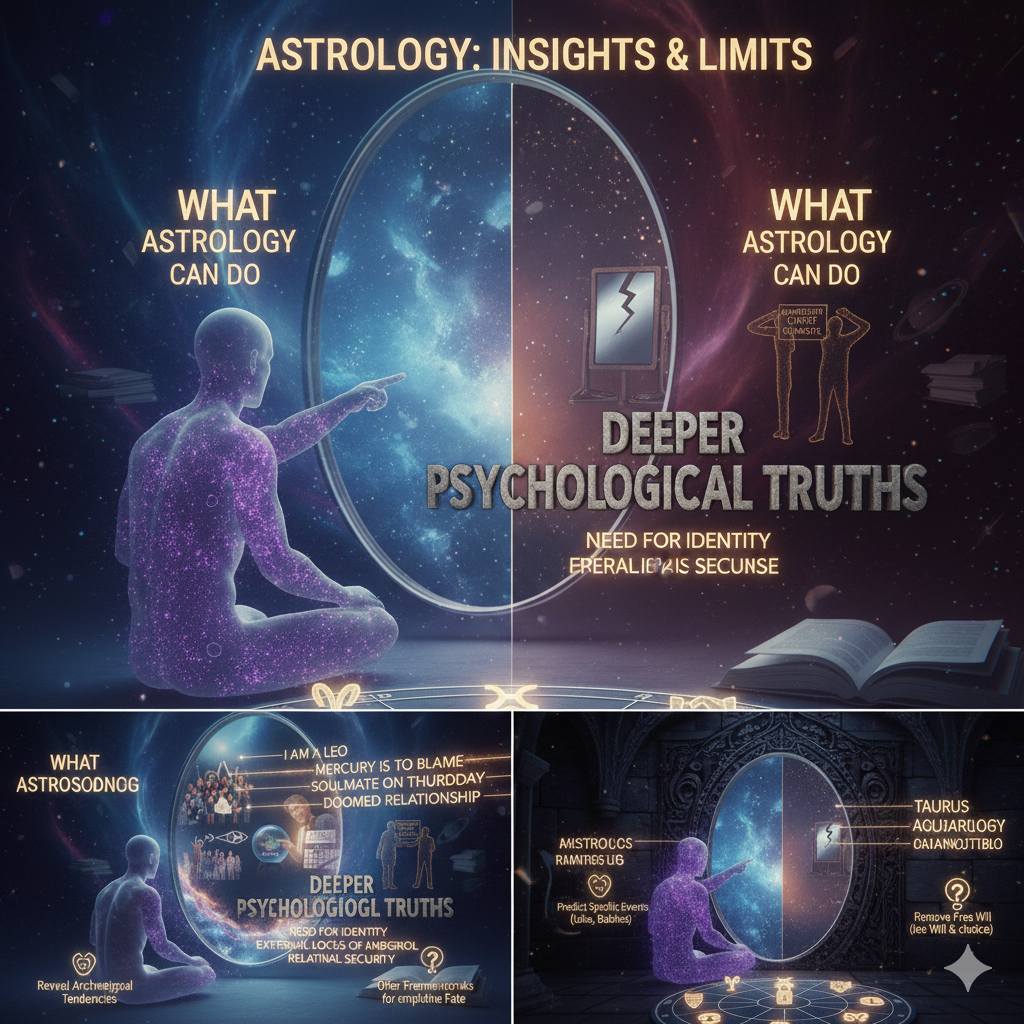
What astrology can and cannot predict becomes clearer when astrology is viewed realistically. Astrology can predict themes, cycles, and psychological tendencies. It cannot predict exact events, remove free will, or replace personal responsibility.
Astrology limitations are not weaknesses. They are boundaries that define its role. Within those boundaries astrology offers meaningful insight, symbolic language, and reflective value.
By understanding astrology vs free will as a partnership rather than a conflict, people can engage with astrology thoughtfully. Tools like calculators can support this engagement when used with context and realism.
Astrology does not tell you what will happen. It helps you understand how you meet what happens. That distinction is where its lasting value lies.
Frequently Asked Questions About Astrology Prediction
What does astrology actually predict?
Astrology predicts symbolic themes and psychological patterns rather than specific events. It highlights periods of focus, challenge, or growth based on planetary cycles. These themes describe tendencies and internal states, not guaranteed outcomes or fixed future events.
Can astrology predict major life events?
Astrology cannot reliably predict specific life events like marriage, career changes, or accidents. It may indicate times when significant decisions or transitions are more likely, but how those moments unfold depends on personal choice and external circumstances.
How does free will fit into astrology?
Free will plays a central role in astrology. Charts describe conditions and tendencies, not forced actions. People respond differently to the same astrological patterns based on awareness, maturity, and personal values, which preserves autonomy and responsibility.
Why do some astrology predictions seem accurate?
Astrology predictions often feel accurate because they use broad symbolic language and archetypal themes. People naturally relate these themes to their experiences. Confirmation bias also reinforces perceived accuracy when interpretations resonate emotionally.
What are the main limitations of astrology?
Astrology limitations include lack of precise event prediction, subjective interpretation, and inability to account for all life variables. Astrology does not replace evidence based decision making, psychological assessment, or practical planning.
Can astrology calculators predict the future?
Astrology calculators accurately calculate chart data and timing of transits. They cannot predict personal outcomes. Calculators provide structural information that supports interpretation but do not replace context, reflection, or individual choice.
Is astrology useful even if it cannot predict events?
Astrology remains useful as a reflective tool. It helps people understand patterns, timing, and emotional cycles. When used without unrealistic expectations, astrology supports self awareness rather than prediction or control.
Recent Posts
- Life Path Number Meaning and Career, Money, and Love Patterns (Psychology-Based)
- How Astrology and Numerology Shape Love, Career, and Life Decisions
- Meet the Top 3 Elegant Zodiac Signs-Elegance Is Written in Their Stars
- These 3 Zodiac Signs Are Born to Speak: Are You on the List?
- Love, Marriage and Relationship Compatibility by Zodiac Sign